
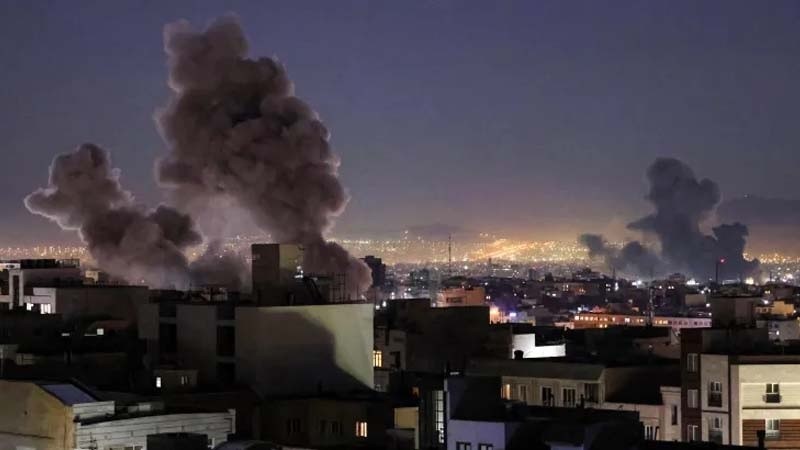
The United States launched extensive attacks on multiple locations in Iran late at night. US forces conducted these strikes in response to a US Apache helicopter being shot down in the Strait of Hormuz. According to Iranian state media, successive explosions occurred in Qeshm Island, Jask, Sirik, and Bandar Abbas.
Washington stated that these actions were taken in response to Iran’s ‘unprovoked aggression.’ However, Tehran has warned of retaliation, raising fears of a new major conflict in the Middle East.
News outlet Al Jazeera reported that the United States carried out a series of attacks on various Iranian facilities after a US Apache helicopter was shot down in the Strait of Hormuz. Following this incident, Tehran also warned of retaliation.
The US military stated that the attacks began around 1:30 AM local time in Iran on Wednesday (June 10). According to them, these strikes were a ‘proportionate response to Iran’s unprovoked aggression’.
Iranian state media IRIB reported that the first round of attacks caused explosions on Qeshm Island in the Strait of Hormuz and in the ports of Sirik and Jask. Later, further attacks and explosions were reported in Jask around 3:30 AM and in Bandar Abbas around 4:30 AM local time on Wednesday.
Earlier on Tuesday (June 9), US President Donald Trump blamed Iran for shooting down the helicopter in the Strait of Hormuz. In a post on his Truth Social platform, he claimed that Iran downed the helicopter while it was on patrol over the Strait of Hormuz.
He stated that a response to this attack was ‘imperative’ for the United States. Trump also added that both crew members of the helicopter had been safely rescued.
Later, Iranian Foreign Minister Abbas Araghchi stated that foreign military forces operating near Iranian territory are ‘always at risk.’ He then warned that the new US attacks would be met with a response.
In a post on X, he wrote, ‘Iranian forces will not tolerate any attack or threat without a response. If you wish to be safe, leave our region.’
Meanwhile, the helicopter downing and subsequent US attacks have further jeopardized the two-month ceasefire. Just the day before, Iran and Israel had exchanged fire for the first time since the ceasefire came into effect.
Iranian state television reported on Tuesday that at least two members of the country’s air defense unit were killed in Israeli attacks.
Furthermore, this US-Israeli conflict against Iran has had a significant impact on the global economy. Fuel prices have risen, and the cost of many essential goods, including food, has also increased.
However, discussions aimed at a permanent settlement are still progressing very slowly. The situation has become particularly complicated due to Israel’s intensified military operations in Lebanon against the Iran-backed armed group Hezbollah.
From Washington, Al Jazeera journalist Allan Fisher reported that the US military believes an Iranian Shahed drone shot down the US Apache helicopter near the Omani coast. Shahed drones are used for one-way attacks.
According to the US military, for the first time in such an operation, an unmanned drone vessel was sent to the scene, and the two pilots were rescued within two hours.
Trump informed US media that despite the helicopter being shot down, both service members are ‘safe and unharmed’.
From Tehran, Al Jazeera journalist Mohammed Val stated that the new US attacks could further escalate the situation. He said, ‘We do not know whether diplomacy will now take priority, as some proposals put forward by the United States are currently under review in Iran.’
In his words, ‘Iran has always said that it keeps the door open for diplomacy and negotiations. However, at the same time, they say they do not trust the United States, because the US and Israel continue to attack Iran and are creating a situation where peace cannot be established.’

