
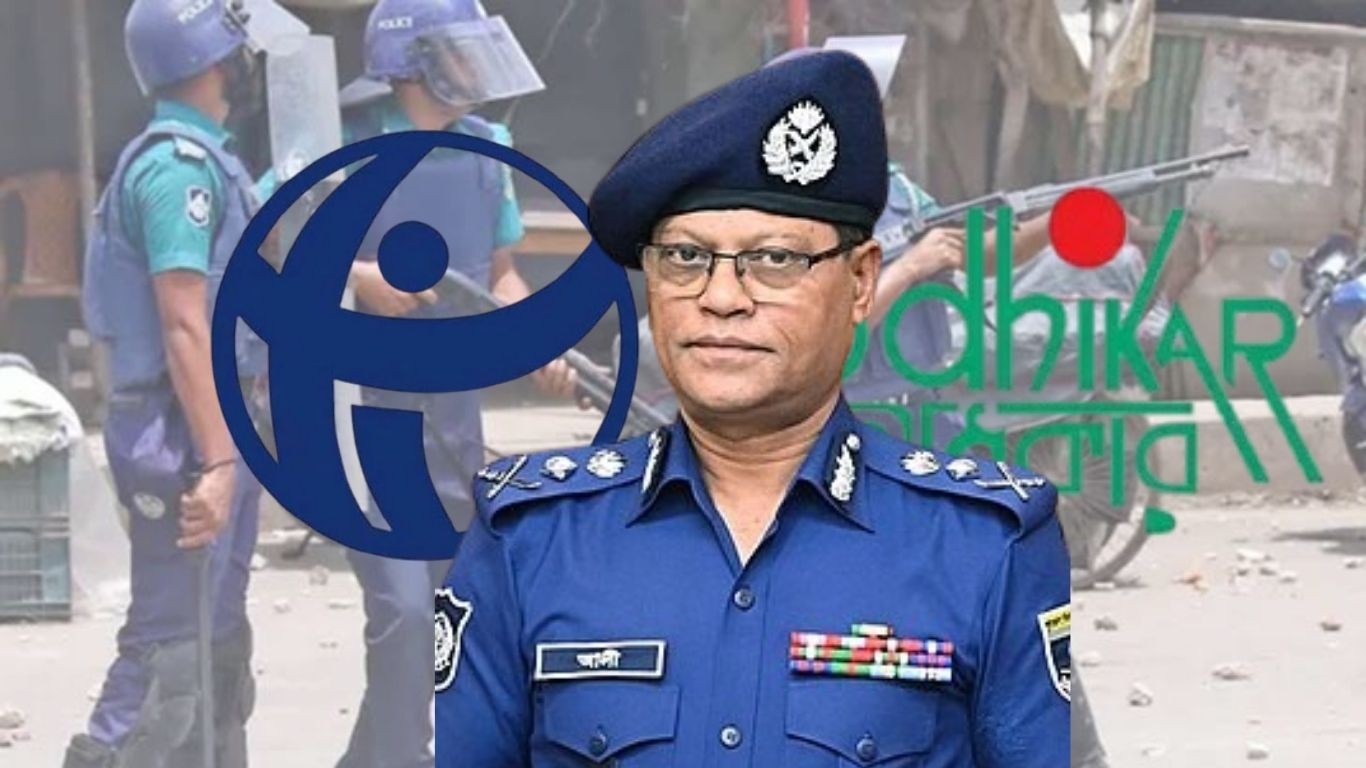
Transparency International Bangladesh (TIB) and human rights organization Odhikar have condemned and protested the statement made by Inspector General of Police (IGP) Mohammad Ali Hossain Fakir, where he said, “Police will not hesitate to engage in crossfire if the government approves it.” According to them, such a statement risks establishing extrajudicial killings as an acceptable method of crime suppression and raises serious questions about the accountability of law enforcement agencies.
In separate statements released on Monday (October 26), the two organizations demanded that the IGP withdraw his statement, ensure accountability regarding extrajudicial killings, and conduct impartial investigations into such incidents.
TIB’s statement noted that bringing forward crossfire as a tool for crime suppression, instead of addressing failures in maintaining law and order and institutional weaknesses, sends a dangerous message.
Dr. Iftekharuzzaman, Executive Director of TIB, questioned whether the police chief is trying to use crossfire to evade responsibility for their own failures in maintaining law and order. He also questioned whether highlighting the possibility of extrajudicial killings, conditional on government approval, amounts to an admission of failure in suppressing crime through lawful means.
Iftekharuzzaman stated that the police’s responsibility is to identify criminals through professional investigation and bring the accused to justice based on acceptable evidence. Presenting crossfire as an alternative is not a solution to institutional weaknesses; rather, it is an example of professional bankruptcy.
He further added that in the same statement, the IGP spoke about fulfilling duties according to law and the constitution, and also about engaging in crossfire if permitted by the government. These two positions are contradictory. No government’s permission can legitimize extrajudicial killings. The rights to protection under the law, life, and personal liberty, safeguarded by Articles 31 and 32 of the Constitution, cannot be revoked by executive decision. Regardless of the gravity of the accusation, the police have no authority to kill anyone by bypassing the judicial process.
TIB’s statement also referenced several notable past incidents. According to the organization, the conviction of police members in the murder case of Major (Retd.) Sinha Mohammad Rashed Khan and the allegations of extortion, torture, and murder through intimidation of crossfire, as revealed in various reports related to the case, serve as a reminder of the horrors of such methods.
The statement also mentioned that the death of Teknaf Councilor Ekramul Haque in an alleged gunfight and the audio released by his family had also raised widespread questions.
The TIB Executive Director also cited the conviction of former RAB officials in the Narayanganj seven-murder case as a judicially established example of abuse of power by law enforcement agencies. He remarked that the IGP must answer what lessons the police have learned from these past incidents.
TIB fears that such a statement from the police chief could be considered a tacit approval of illegal use of force at the field level. When the possibility of crossfire is mentioned in the statement of someone whose responsibility is to operate the force within the bounds of the law, questions about leadership accountability naturally arise.
TIB’s statement mentioned that on September 14, the Law Minister had stated that the government would not resort to crossfire to suppress terrorism; it is possible to suppress terrorism with existing laws.
In this situation, the organization called for an explanation as to why there is an inconsistency between the IGP’s statement and the government’s declared position. Simultaneously, TIB demanded that the IGP withdraw his statement, offer an unconditional public apology, and ensure his accountability. The organization also called for his removal from duty until accountability is ensured.
Emphasizing that police use of force must be lawful, necessary, and proportionate, TIB stated that, according to international standards, the intentional lethal use of firearms is acceptable only in strictly unavoidable circumstances to protect life. There is no scope to view this limited allowance as approval for extrajudicial killings.
TIB also expressed concern regarding the allegation that journalists criticize the police when they do not receive money.
According to the organization, if there is a specific allegation of crime against any journalist, legal action must be taken based on evidence. Blanket accusations can jeopardize the media’s role in oversight and accountability and risk discouraging independent journalism.
The statement also noted that while it is necessary to ensure the police’s working environment and capabilities, this cannot be an argument to avoid legitimate criticism.
On the other hand, in a separate statement, human rights organization Odhikar stated that during Sheikh Hasina’s 15.5 years in power, numerous incidents of extrajudicial killings, disappearances, and torture occurred in Bangladesh. The organization claimed that dissidents, political activists, and ordinary people were subjected to widespread human rights violations during that period.
Odhikar’s statement further added that judicial proceedings were later initiated against members of law enforcement agencies on allegations of human rights violations. Against the backdrop of these incidents, it is alarming that the possibility of crossfire has been mentioned by a person holding the highest position in the police force.
The organization claimed that since the current BNP government took power, they have documented five incidents of extrajudicial killings. Odhikar expressed deep concern about whether such incidents might increase following the IGP’s statement.
Odhikar demanded the withdrawal of the IGP’s statement and stated that incidents of extrajudicial killings that have occurred during this period must be investigated impartially and fairly. The organization also called for those against whom evidence of allegations is found during the investigation to be brought under the law and subjected to justice.
According to TIB and Odhikar, instead of creating opportunities for extrajudicial killings in the name of crime suppression, the state’s priority should be to ensure lawful investigations, evidence-based justice, and accountability of law enforcement agencies.

