
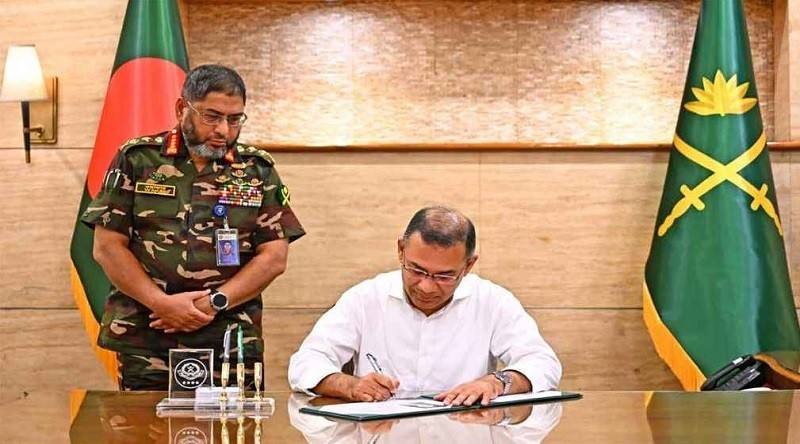
Prime Minister Tareque Rahman has stated that the government is committed to building a modern and technology-driven army in line with contemporary demands. He made these remarks on Sunday (July 26) during his address as the chief guest at the inaugural session of the ‘Army Headquarters Selection Board-2026’ held at the Army Headquarters in Dhaka Cantonment.
The Prime Minister noted that Bangladesh currently faces multifaceted and complex security challenges, including maritime security, border security, interstate and cross-border threats, cyber and information security, disaster management, and humanitarian assistance. Therefore, he emphasized, it is imperative to adopt a realistic and sustainable model for defense modernization, taking into account Bangladesh’s geographical location, economic capabilities, national security needs, and the expectations and resilience of its people.
Tareque Rahman affirmed, “As the head of government and concurrently the Minister of Defense, I believe that the fundamental strength of Bangladesh’s defense system lies not merely in the capabilities of the armed forces, but rather in the unity, preparedness, and resilience of the entire nation.”
He added that, with this objective, a modern policy would be formulated based on the vision of Shaheed President Ziaur Rahman. This policy would ensure that the armed forces, law enforcement agencies, civil administration, industry, technology, educational institutions, and the general populace work together as part of an integrated national security framework. The aim of this policy is not to encourage war, but to foster a constantly prepared, stable, and self-reliant armed force capable of addressing any potential crisis, aggression, or disaster, thereby fully safeguarding the country’s sovereignty, independence, and national interests.
Addressing the generals present, the Prime Minister stated that the nature of warfare has changed in modern times. Security, he explained, is no longer limited to protecting geographical borders but now encompasses cyberspace, information warfare, drone technology, artificial intelligence, and regional geostrategic competition. Therefore, the government seeks to further strengthen the defense system by enhancing capabilities in drone technology, satellite surveillance, cyber, and electronic warfare.
He further mentioned that, in this continuum, the government is working to formulate a roadmap for the modernization and development of the armed forces. “Our goal is the future development of the forces, where emphasis will be placed on capability over quantity, effectiveness alongside expansion, technological innovation instead of platform proliferation, and jointness over single-force-centric development,” he said.
He added that the government’s core themes for the development of the armed forces include: forming a disciplined, modern, and strong armed force; strengthening integrated defense planning; formulating contemporary defense policies and strategies; fostering the growth of the indigenous defense industry; and solidifying democratic civil-military relations.
The Prime Minister expressed his belief that this Selection Board, established to evaluate and recognize deserving individuals based on merit, qualification, skill, and integrity, would restore discipline in postings and promotions. He also hoped it would lay a solid foundation for visionary and professional leadership in the army for the coming days.
He noted, “I feel a sense of pride in any success of the army, and conversely, I feel unease at any negative news concerning the army.”
The Prime Minister shared, “The Cantonment is a place of deep emotion and cherished memories for me. As you know, my adolescent and young adult years were spent in a military environment, both at home and outside. Consequently, I am quite familiar with the army’s rules, discipline, and regulations. Because of these reasons, whenever I speak about the army, I become somewhat nostalgic.”
He added, “I grew up within the discipline and systematic order of the military environment, alongside my parents and only younger brother. I have always considered the army to be a part of my larger family.”
He further stated, “At this event today, I respectfully remember the Proclaimer of Independence, the heroic freedom fighter Shaheed President Ziaur Rahman. As an army officer, by declaring independence, then-Major Zia transformed the army into an integral part of Bangladesh’s independence and liberation war history. This is undoubtedly a glorious chapter for the country’s army.”
The Prime Minister observed that despite the army’s glorious role in the Liberation War, soon after independence, there was a noticeable attempt to tarnish its image and create instability within it. He credited former Army Chief Shaheed Lieutenant General Ziaur Rahman’s firm and far-sighted leadership for ushering in a new era of discipline and professionalism in the army during that turbulent period.
He highlighted that since the very beginning of independence, army personnel have worked tirelessly to maintain security and stability in the Chittagong Hill Tracts (CHT). He noted that the ongoing ‘Border Road’ project, spanning approximately 1,036 kilometers in the hilly and border regions, not only ensures border security but also opens up new possibilities for the livelihoods and economic activities of people in remote areas.
The Prime Minister also informed that the army is currently engaged in clearing mines and explosives from an area of 1,200 square meters in the hilly regions. He expressed his deep condolences and gratitude to the families of the 217 brave army members who were martyred while serving in peacekeeping and counter-terrorism operations in the Chittagong Hill Tracts.
He proudly stated that the Bangladesh Army’s reputation is well-established in the international arena today. By performing duties with efficiency, professionalism, and dedication in UN peacekeeping missions, Bangladesh has achieved special glory and prestige on the world stage in recent years as the top contributor of peacekeepers.
Tareque Rahman mentioned that recently, Bangladesh Army members have upheld the country’s honor on the international stage by performing their duties with great skill and professionalism in the Central African Republic, South Sudan, and Mali. However, he noted, this glorious achievement comes with a history of self-sacrifice.
He lamented that six members of the Bangladesh Army peacekeeping mission were martyred in a drone attack in South Sudan on December 13, 2025. He offered prayers for the departed souls of the martyrs and expressed his deep condolences to their bereaved families.
Tareque Rahman expressed his belief that the democracy-loving people would positively evaluate the responsible role played by the army during the historic student-people’s mass uprising of 2024 and the subsequent critical period after August 5. He also commended the army’s praiseworthy role throughout the interim government’s tenure in maintaining law and order, ensuring security in industrial areas, and helping to restart the stalled economy.
He emphasized that the army’s unreserved assistance in successfully conducting the free and fair elections on February 12 was primarily a unique manifestation of its deep institutional belief in democratic norms and regulations. Additionally, he noted, the army played a crucial role in maintaining normalcy by efficiently and prudently managing oil storage facilities during the global fuel crisis.
The Prime Minister praised the Bangladesh Army’s highly commendable role in defending the country’s sovereignty, combating terrorism in the Chittagong Hill Tracts, and participating in UN peacekeeping missions.
He further stated that in any national crisis, including infrastructure development, post-disaster rescue operations, and managing the July mass awakening and flood situation, the army has always played a leading role.
He also observed that during the fascist rule, every institution in the country had lost its professionalism, and the army too had faced undesirable adverse situations. Now, in a democratic environment, the army must regain the trust of the people through its competence, skill, and professionalism.
The Prime Minister asserted that the ‘Army Headquarters Selection Board’ can play a revolutionary role in establishing professionalism by following certain specific policies for promotion and posting. He stressed that merit and qualification should be the primary criteria for an army officer’s promotion.
He added that an officer’s physical fitness and physical appearance should be among the foremost considerations for promotion.
Referring to physical fitness and regular exercise, the Prime Minister found a quote by the late American General ‘Norman Schwarzkopf’ particularly relevant.
He quoted General H. Norman Schwarzkopf: “The more you sweat in peace, the less you bleed in war.” Therefore, he concluded, there is no scope for compromise on discipline and fitness at any level in the army.
The Prime Minister expressed his hope that the officers selected through this selection board would further strengthen the Bangladesh Army’s continuity of success, glory, and professionalism. He stated that the current government’s philosophy is ‘Bangladesh First’ in protecting the country’s interests, and ‘Bangladesh for All’ in protecting the interests of the people.

