
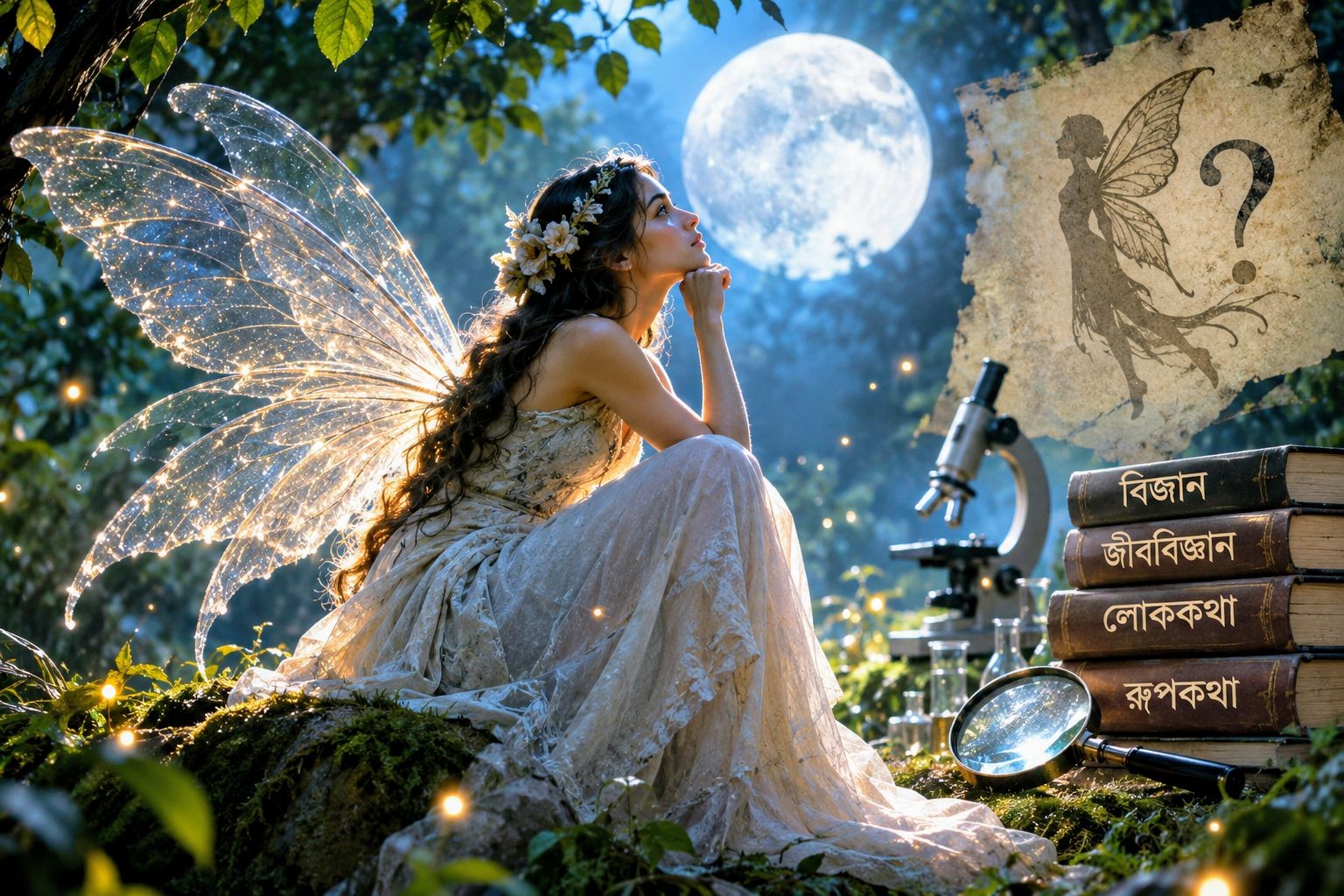
In the realm of human imagination, fairies are enigmatic characters. For hundreds of years, fairies have appeared in folklore, myths, literature, and culture across various regions of the world. Sometimes they are depicted as exceptionally beautiful women, sometimes as tiny winged humanoids, and other times as an invisible entity with supernatural powers. However, in the age of modern science, one question still remains at the core of human curiosity—do fairies truly exist on Earth?
Scientists have been researching the Earth’s biodiversity for a long time. From deep oceans to inaccessible mountains, from dense forests to ice-covered polar regions—life has been sought in almost all types of environments. New species of animals and plants are identified every year. However, no scientific evidence for the existence of creatures like the fairies described in fairy tales has been found to date.
What Does Science Say About Fairies?
From a scientific perspective, establishing the existence of any creature requires observable and verifiable evidence. Physical samples of the creature, fossils, genetic information, reliable photographs, or independently verifiable observations play a crucial role.
In the case of fairies, no such acceptable evidence has been found. No recognized scientific research on Earth has yet confirmed the existence of winged, humanoid, supernatural beings.
According to biologists, it is not possible for a creature with a human-like physique to fly merely by having a pair of wings on its back. Flight requires a suitable skeleton, powerful muscles, sufficient energy production capacity, and a body structure consistent with aerodynamics.
The flight capability of birds, bats, and insects is the result of long evolutionary processes. However, the combination of a human-like body, small wings, and the ability to fly freely in the sky, as described in fairy tales, has not been observed in the real biological world.
Where Did the Concept of Fairies Originate?
Research in history and folklore shows that the concept of fairies is not limited to a single country or civilization. Stories of supernatural human-like entities are prevalent in various cultures around the world.
In European folklore, characters known as ‘Fairies’ are associated with nature, forests, mountains, rivers, and magic. In some ancient beliefs, these entities were described as benevolent helpers of humans, while in others, they were portrayed as dangerous and mysterious.
On the other hand, ‘Peri’ or ‘Pori’ (fairy) is a familiar character in Persian literature and folklore. Through Persian cultural influence, the concept of fairies spread widely into the literature and imaginative tales of South Asia.
In Bengali fairy tales, fairies are typically symbols of beauty, miraculous powers, and mystery. The presence of fairies is often seen alongside princes, princesses, magical lands, and strange events.
However, the appearance or characteristics of fairies are not uniform across all cultures. In some, they are human-like, in others miniature, and in some, there is no description of a visible body at all. Consequently, there is no universally accepted definition of what exactly constitutes a fairy.
What Do Fairies Actually Look Like?
The most prevalent idea about fairies is that they are exceptionally beautiful and possess distinct characteristics compared to ordinary humans. In modern art, films, and animation, fairies are often depicted with transparent wings on their backs, radiant attire, and magic wands.
However, historically, fairies were not always imagined in this way. Many old European folk tales described fairies as being human-sized or sometimes even fearsome entities.
According to researchers, people’s common perception of a fairy’s appearance has primarily developed through literature, art, folklore, and popular culture. As no fairy has been identified in reality, there is no opportunity to provide a scientific description of their true appearance.
In other words, science has no answer to the question of what fairies look like. This is because it is impossible to determine the physical characteristics of an entity whose existence has not been proven.
Why Do Many Claim to Have Seen Fairies?
In various countries, both in the past and present, some individuals have claimed to have seen fairies or mysterious human-like entities. However, personal experiences or eyewitness accounts alone are not sufficient to establish the existence of a supernatural creature.
Psychological research shows that the human brain often interprets ambiguous sights, light and shadow, or unfamiliar shapes as recognizable figures. This tendency is called ‘pareidolia’.
Furthermore, in the transitional state between sleep and wakefulness, some people may experience sights or presences that have no real external source. Sleep-related hallucinations or experiences of sleep paralysis are sometimes interpreted as supernatural events.
However, these explanations do not mean that every claim of seeing a fairy has the same underlying cause. To provide a scientific explanation for a specific event, relevant data and evidence must be examined separately.
Can Fairies Live Like Humans?
In fairy tales, fairies are sometimes seen talking to humans, forming friendships, and even falling in love. In some stories, fairies come to live in the human world and can make themselves invisible when needed.
However, from a biological perspective, the survival of any creature requires fundamental biological processes such as food, energy, metabolic activities, and reproduction.
For fairies, there is no scientific data on these matters. There are no experimentally verified answers to questions like what they eat, how they reproduce, how long they live, or what their body structure is like.
Therefore, the idea of fairies living like humans remains confined to fiction and folklore.
Why Haven’t Fairies Been Found Even in the Age of Technology?
In the current world, almost every person has a smartphone with a camera. Automated cameras are used for forest observation, and modern technology is employed for wildlife identification. Satellites, drones, and advanced image analysis systems have also expanded research opportunities.
Despite such technological advancements, no acceptable samples or observations sufficient to confirm the existence of fairies have been found.
From time to time, content claiming to be photos or videos of fairies spreads on the internet. However, the authenticity of any photo or video cannot be confirmed merely by viewing it. Digital editing, computer-generated imagery, and artificial intelligence can now create highly realistic fictional scenes.
Consequently, to verify such claims, the original video, recording circumstances, potential edits, and evaluation by independent experts are required.
So, Is the Existence of Fairies Completely Impossible?
Science typically makes decisions based on evidence for or against a subject. The lack of acceptable evidence for the existence of fairies to date is a scientific position. However, not finding evidence and conclusively proving something’s existence is impossible are not the same thing.
There could still be countless unknown species on Earth. Particularly, there is potential for discovering new species in deep seas and inaccessible environments. However, the possibility of discovering a new species cannot be considered proof of the existence of fairy-tale fairies.
If an unknown creature resembling a fairy were ever discovered, it would also have to undergo scientific examination and classification like all other living organisms.
Why Are Fairies So Popular in Human Imagination?
According to experts, an important aspect of myths and folklore is that they reflect human hopes, fears, desires, and social values.
Fairies sometimes symbolize beauty, sometimes act as saviors from danger, and sometimes represent a mysterious power beyond ordinary human capabilities.
From children’s literature to films, from plays to social media—the concept of fairies has taken on new forms across various mediums. While their attire, appearance, and character have changed over time, human interest in them has not diminished.
Whether fairies exist in reality or not, their position in the human imagination is extremely powerful.
What Does Science Ultimately Say?
Based on scientific data, it can be said that the existence of fairies described in fairy tales has not yet been proven on Earth. There is no reliable scientific evidence for fairies’ wings, magical powers, ability to become invisible, or their capacity to live like humans.
However, in literature, folklore, and cultural heritage, fairies remain an important fictional character.
Humans once considered many unknown natural phenomena to be miraculous. Science has gradually provided numerous explanations for those events. But some concepts, like that of fairies, still primarily reside in the realm of human imagination and belief.
Therefore, for now, the scientific answer to the question is only one—there is no acceptable evidence for the existence of fairies on Earth. However, fairies continue to roam in human imagination.

