
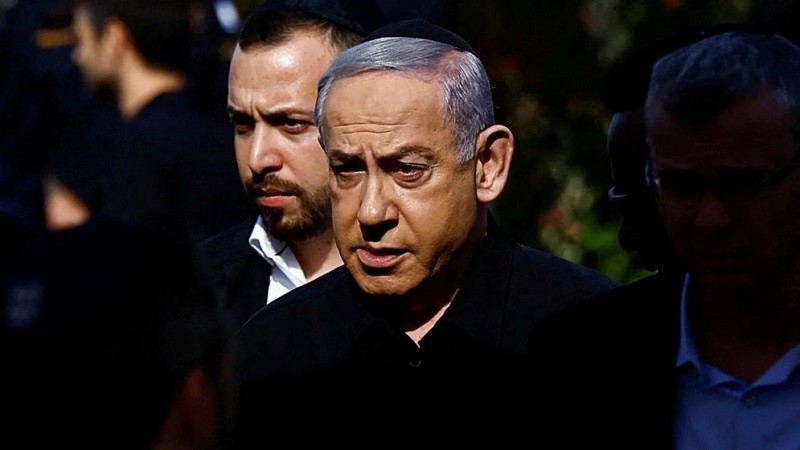
Israeli Prime Minister Benjamin Netanyahu has stated that Israel’s military operation in the Middle East will not end soon. In his words, there is ‘no end’ to Israel’s war in the region.
He made these remarks in a long and rare interview given to Israel’s Channel 14 News on Tuesday (June 30).
In response to a question during the interview about whether Israel’s war in the Middle East was coming to an end, Netanyahu indicated that the country’s military operations would continue.
Highlighting Israel’s military presence in various areas of Gaza, Lebanon, and Syria, along with the killing of top Hamas and Hezbollah leaders, he stated, ‘We have achieved unprecedented success.’
Referring to recent Iran-Israel tensions, Netanyahu said, ‘We have broken the wall of fear. No one dared to attack Iran for 47 years.’
When asked whether the goal of achieving ‘assured victory,’ declared after the Hamas-led attacks on October 7, 2023, was still realistic, he responded, ‘There is no end to it.’
Netanyahu claimed that there is no alternative to being strong to survive in the Middle East and the world. According to him, ‘Israel is now stronger than ever before.’
At one point in the interview, he said that many did not believe Israel would achieve its war goals. He then addressed the audience, saying, ‘Isn’t anyone applauding?’ After this, the audience was seen applauding.
When questioned about the exodus of Gaza residents, Netanyahu corrected the term ‘exodus’ to ‘voluntary exodus.’ Without elaborating, he stated, ‘I prefer to speak less and work more.’
When asked about plans for Jewish settlements in Gaza, he did not answer directly. Instead, he said, ‘The big question is—will you work, or will you just talk?’
Netanyahu also stated that Israel is under pressure from various countries. However, in his words, ‘I don’t need to challenge the whole world every moment and on every issue.’
Israeli Students Now More Racist: Survey
For the first time since the start of the war in Gaza, Israel’s new generation of students will vote in the national elections next October. In this context, a report by the Israeli daily Haaretz claims that the current generation of graduate students holds significantly more racist views than their predecessors.
The report states that a significant increase in racist attitudes has been observed among Israeli adolescents in recent years. Youth workers and educators have expressed concern about the social and political implications of this trend.
According to data from a 2025 survey conducted by Israel’s Ministry of Education, there has been an increase in the number of students who believe that some communities in Israel—such as Palestinian citizens of the country—do not have the right to be part of society.
The survey found that 52% of students in religious schools and 35% in secular schools agreed with this view. Among students in Arabic-language schools, this rate was 34%.
A youth movement official told Haaretz that nationalistic sentiments among Jewish students have become more intense than before. Concurrently, interest in a strong Jewish identity and the mentality of participating in military conflicts have also increased.
Another youth organizer stated that while fear of Arabs has increased among Jewish students, a greater concern is their diminishing trust in the state’s democratic institutions.
The report further stated that many Jewish graduates from the secular education system no longer believe in the possibility of peaceful coexistence with Palestinians or political solutions.
The headmaster of a Jewish high school told Haaretz that many students of the current generation no longer trust the idea of establishing peace or a political resolution to the conflict between the two nations.
A ‘Tsunami’ of Mental Health Problems
Israeli media outlet Ynet reported on Wednesday (July 1) that a new study warns of the severe psychological impact of prolonged war on the children of reserve soldiers.
This study, conducted by Reichman University, analyzed data from approximately 2,500 reserve soldier families. It found that a large number of children under the age of seven are exhibiting symptoms of post-traumatic stress disorder (PTSD).
According to the study, 75% of children of reserve soldiers exhibit sub-clinical PTSD symptoms, and nearly 32% of those showing symptoms are suffering from clinical or severe PTSD.
The study warns that these children are under severe stress, both mentally and physically. If they do not receive timely and necessary treatment and support, Israeli society may have to bear the long-term consequences.
According to Reichman University, not only children but also 35% of fathers and 42% of mothers who participated in the survey are experiencing varying degrees of psychological trauma.
The study states that as a result of the war, which has lasted for nearly three years, Israel is increasingly becoming a society plagued by psychological trauma. Families of reserve soldiers, especially those with young children, have been enduring severe mental and social crises for a long time.
The study further noted that the daily lives of many reserve soldier families are often becoming chaotic, and the country is facing a growing mental health crisis.
Children are exhibiting various mental and behavioral complications, including sleep problems, bedwetting, and aggressive behavior. Concurrently, nearly 80% of parents who participated in the survey reported that the war has negatively impacted almost every aspect of their lives.
Source: Middle East Eye

