
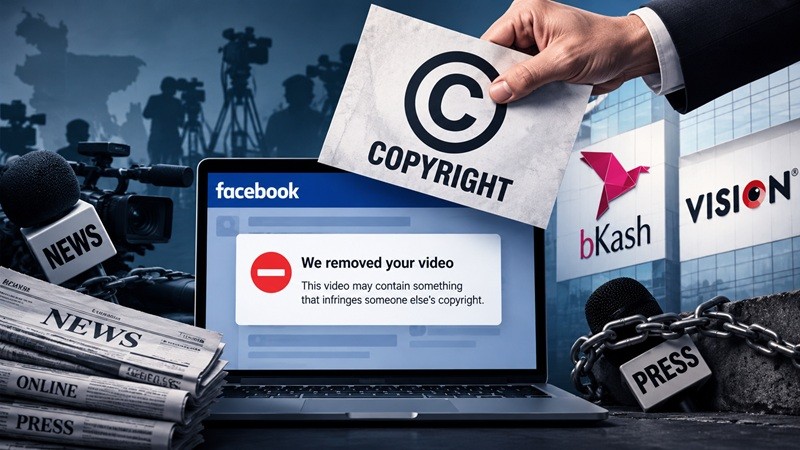
The purpose of copyright is to protect creative works and intellectual property. However, if the very system designed to protect the rights of creative individuals becomes a tool to withhold news, criticism, or public interest information from people, the situation becomes alarming. Recent experiences of journalists and digital media in Bangladesh bring this question to the forefront: Is the digital system of copyright protection being used as a ‘weapon’ against news media in some cases?
Recently, BD24live faced such an experience. A news video published by BD24live regarding the mobile financial service provider bKash was removed by Facebook after an Intellectual Property (IP) complaint. The notification received from Facebook named bKash as the complainant.
The video, titled ‘Agent’s Explosive Claim: bKash Software Developers Responsible for Fraud!’, featured an agent’s statement. BD24live authorities state that the video was not taken from any third party; their own representative directly captured the interview. The BD24live branded boom is clearly visible in the original video. The video is also published on the institution’s YouTube channel.
Following the incident, BD24live inquired with the complaining party about which specific part of their self-recorded news video infringed their intellectual property rights. Simultaneously, an appeal has been filed against Meta’s decision.
This is not the first time. Earlier, another news video by BD24live concerning the electronics brand Vision was also removed from Facebook following a copyright complaint, according to the news outlet.
However, the problem is not limited to BD24live alone.
In August of this year, journalist G M Mashiur Rahman Milan from Patuakhali’s Bauphal complained that after his own Facebook Live video was published by another news outlet, his original video was subsequently hit with a copyright claim via Facebook Rights Manager. According to his complaint, this resulted in his original video being globally blocked. A legal notice was later sent to Channel i regarding the matter. Channel i had then stated that appropriate action would be taken after reviewing the notice.
A broader picture emerged from an investigation by the digital investigative news outlet, The Dissent. The organization reported that various images used in their fact-check and investigative reports were successively removed from Facebook due to copyright claims. According to their investigation, they found information on at least 25 such claims within just 15 days. A more serious allegation was that while some claims used the names of well-known news organizations or institutions, the email addresses associated with the complaints were not the official addresses of the respective organizations.
This means there’s another dimension to the problem. Not only complaints from genuine institutions or rights holders, but also fake or questionable copyright claims using someone else’s identity can become a threat to digital content.
Similar risks are not confined to copyright alone. In July, an investigation by Netra News revealed allegations of misuse of Facebook’s reporting system to deactivate Facebook accounts of Bangladeshi journalists and activists. The report also highlighted the incident of a journalist from The Daily Star having their account deactivated.
Such complaints are not new. Freedom House’s 2021 Bangladesh Internet Freedom Report mentioned allegations of using baseless copyright complaints against critical websites and YouTube channels.
The incidents are separate, and the complainants are also different. Therefore, there is no evidence to consider them part of a coordinated campaign. However, these incidents point to a common vulnerability: if digital platforms’ copyright, intellectual property, and reporting systems are misused, news media content can quickly become inaccessible to people.
This creates a significant difference between traditional media and digital news media.
If a newspaper publishes a complaint about an institution, the institution can send a protest, provide an explanation, request a correction, or, if necessary, resort to legal action. In such cases, both the complainant and the news organization have the opportunity to present their statements.
However, on platforms like Facebook, if a news item immediately disappears after a copyright or IP complaint, and the news organization later has to appeal to restore it, even if the appeal is successful, the damage may not be fully recovered. News is a time-sensitive product. Even if today’s important news is reinstated a few days later, a large part of its immediate readership, shares, discussion, and impact may have already been lost.
And for this very reason, a copyright complaint is not limited to just removing a post. If such incidents happen repeatedly, there is a risk of affecting the concerned news outlet’s page standing, distribution, and the visibility of future content.
Meta’s own system allows users to appeal if content is removed due to a copyright report. The company has also publicly acknowledged the importance of original news reporting. Meta has stated in the past that breaking news, new interviews, eyewitness reporting, and original investigations are considered important journalism.
A fundamental question thus remains: If, on one hand, the platform emphasizes original journalism, and on the other hand, content is removed immediately upon an IP claim against that very original journalism before verification, where is the protection for news media?
Individuals working on digital rights have also expressed concern about this issue. In a statement to The Dissent, Manisha Biswas, a legal expert at Bangladesh Legal Aid and Services Trust (BLAST), described the misuse of the copyright system as an impediment to freedom of expression online. She also opined that alongside reforms to content removal and strike systems, there should be an opportunity for concerned parties to present their views before content is removed.
In this reality, the responsibility of news media is also significant. They must adhere to copyright law when using others’ videos, photos, music, or creative works. At the same time, they must be prepared to prove ownership of their own journalism. Raw footage, original files, metadata, recording time, reporter’s identity, and first publication information are no longer just matters for newsroom archives; in an IP dispute, these can become crucial evidence.
However, the entire burden cannot be placed on news media. The platforms’ reporting architecture needs to be designed in such a way that genuine rights holders can quickly protect their rights, while also ensuring that no one can easily remove legitimate news, criticism, or public interest information from public view by exploiting a complaint opportunity.
Especially when an institution claims copyright or IP against a news organization’s self-recorded interviews or field footage, the necessity of human review alongside automated systems comes to the forefront. The answer to the question of which original work the complainant owns and which part of the accused news was illegally used is crucial in making a decision.
Because in the digital age, shutting down printing presses or locking up websites is not the only way to silence news media. Removing important reports from a news outlet’s Facebook Page, repeatedly issuing strikes, putting accounts at risk, or curtailing distribution can ultimately narrow the path for news to reach people.
BD24live’s experiences concerning bKash and Vision, and other incidents faced by journalists and news organizations, thus leave a big question: Can technology designed to protect intellectual property become a new kind of ‘digital weapon’ against independent journalism through misuse?
Strict action against genuine copyright infringement is necessary—there should be no disagreement on this. But at the same time, it must be ensured that copyright complaints do not become a shortcut to remove uncomfortable news about an institution, customer complaints, investigative reports, or public interest statements.
Let copyright remain a shield for creativity—not a ‘digital weapon’ to silence journalism.

