
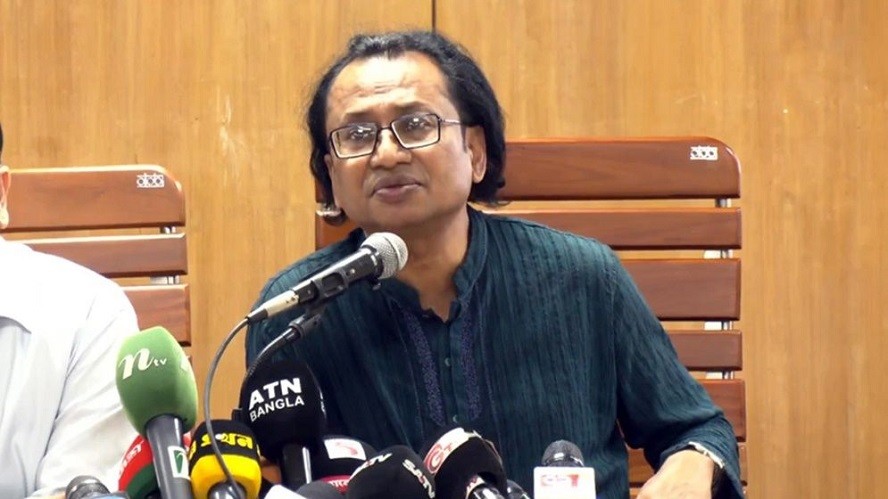
Dr. Zahed Ur Rahman, the Information and Broadcasting Advisor to the Prime Minister, has expressed optimism that the ongoing load shedding due to the country’s electricity crisis will significantly reduce in a very short period. He stated that the burden of the crisis is now being distributed comparatively evenly between urban and rural areas, instead of solely on rural regions. Consequently, load shedding has recently increased in Dhaka and other major cities.
He made these remarks at a press briefing organised at the Secretariat on Tuesday (September 1) regarding the progress of various government activities.
Zahed Ur Rahman mentioned that the government has initiated efforts to release detailed information on the load shedding situation. The government is working to improve the energy situation, and the current level of load shedding is expected to decrease considerably very soon.
He explained that in the past, electricity supply to the capital and other major cities was largely ensured, while rural and remote areas experienced comparatively more load shedding. The current government has changed that policy, deciding to share the burden of the crisis among everyone. As a result, load shedding is now also being observed in Dhaka.
The Information Advisor noted that there are economic justifications for prioritising electricity supply to major cities, as these areas host more industrial, commercial, and other economic activities. However, he clarified that increased power supply to cities is not due to the influence or power of urban dwellers. Instead, everyone is now comparatively sharing the hardship of load shedding during the current crisis.
He further informed that detailed information on the actual extent of load shedding during the Awami League government and subsequent interim government’s tenure, despite claims of ‘uninterrupted electricity’ supply, will also be published. Data collection and analysis are underway, and he hopes these details can be presented to the public by next week.
Zahed Ur Rahman attributed the current power crisis to fuel shortages, sudden mechanical failures at power plants, maintenance issues across various facilities, limitations of the transmission grid, and a rapid increase in electricity demand.
He pointed out that under a democratic government, economic activities generally increase. As trade, industrial production, and various other activities grow, so does the demand for electricity. During the interim government’s period, economic activities were comparatively lower, leading to somewhat lower electricity demand. The current increase in economic activities has created additional pressure on electricity supply.
Highlighting government measures to tackle the crisis, he stated that the supply system is being adjusted to keep rural load shedding at a tolerable level and to avoid prolonged power outages in any single area. As part of this, load shedding is being implemented as needed in areas under DPDC and DESCO in Dhaka city. The saved electricity is then reallocated to other regions of the country, especially rural areas.
He claimed that this government initiative is improving the electricity supply situation for industries and other important customers outside Dhaka, while simultaneously reducing the pressure of prolonged and frequent load shedding in rural areas.
Zahed Ur Rahman acknowledged that the country is currently going through a crisis, and therefore, everyone must endure some hardship. However, he assured that this situation will not be long-lasting. Necessary initiatives are being taken to address the crisis, and the situation will improve very soon.
Chittagong Port’s Capacity to Increase with Laldia Terminal
During the press briefing, the Information Advisor also highlighted the progress of the Laldia Container Terminal project, aimed at increasing and modernising Chittagong Port’s capacity.
He announced that the initiative to construct the Laldia Container Terminal, with cooperation from Denmark, has been undertaken to further boost the country’s foreign trade and enhance Chittagong Port’s capacity. The groundbreaking ceremony for the terminal took place on August 30 at the project site on the bank of the Karnaphuli River in Patenga, Chittagong.
The project will be implemented under a Public-Private Partnership (PPP). He expressed hope that once operational, it will increase Chittagong Port’s cargo handling and container management capacity, thereby accelerating the country’s import and export activities.
No Fertilizer Crisis in the Country: Information Advisor
Zahed Ur Rahman also asserted that there is currently no fertilizer crisis in the country. He mentioned that temporary issues had arisen in the supply and distribution system in one or two areas, which are now being addressed.
He stated that the country currently holds a total stock of 1.2861 million metric tons of fertilizer, including Urea, TSP, DAP, and MOP. In the same period last year, the total stock was approximately 1.2 million metric tons. This indicates that the current fertilizer stock is equal to or slightly higher than last year.
While acknowledging temporary problems at the distribution level in some places, he clarified that such issues were not widespread. Efforts are underway to resolve problems in affected areas. Therefore, the problem was with the distribution system in some locations, not with fertilizer stock.
New Policy for E-rickshaws on the Way
The Information Advisor also announced that work is progressing on formulating a new policy for the operation and management of battery-operated three-wheeler e-rickshaws across the country, including Dhaka.
He said that the increasing number of battery-operated e-rickshaws in the capital and other areas has led to some disorder in their operation and management. An initiative has been taken to bring this reality under an organised policy framework.
A discussion meeting on this matter was held on August 25 at the Local Government Division’s conference room, involving various relevant stakeholders. State Minister Mir Shah Alam chaired the meeting.
The proposed policy will include provisions for determining the mechanical and technical specifications of e-rickshaws, licensing drivers, registering vehicles, and specifying which roads or areas these vehicles can operate on.
Zahed Ur Rahman emphasized that e-rickshaws have become a part of the country’s reality. Therefore, instead of completely ignoring them, an initiative has been taken to bring them under an effective policy. He expressed hope that a swift formulation of the policy would significantly reduce the existing disorder and management problems surrounding e-rickshaw operations.

