
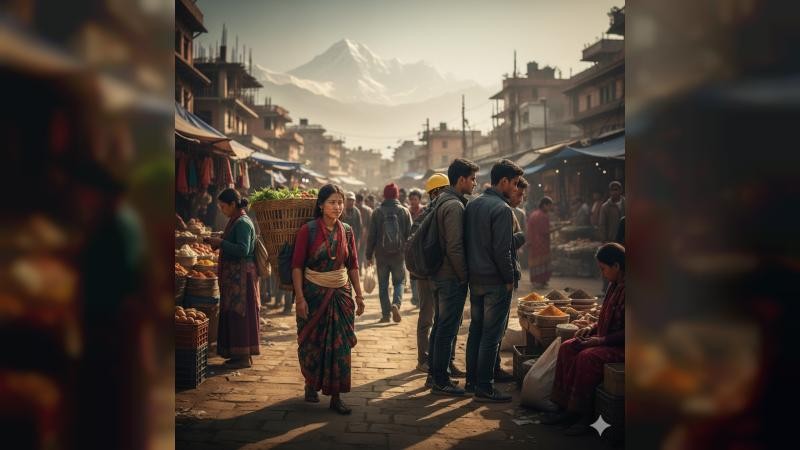
Masudur Rahman, Returning from Nepal: Nepal, a land of unparalleled natural beauty, is one of South Asia’s gems. Situated at the foothills of the Himalayas, the country’s economic backbone primarily relies on tourism, agriculture, and remittances. However, in recent years, Nepal’s job market and the daily lives of its ordinary citizens have witnessed a new dynamic. The contrasting opportunities in the government and private sectors, coupled with rising unemployment, shape a mixed experience for Nepalis.
A significant disparity in opportunities and benefits exists between the public and private sectors within Nepal’s labor market. For Nepali youth, ‘Nijamati Seva’ or government service is highly prestigious. It offers not only job security but also benefits like pensions, insurance, and housing. However, due to the limited number of government positions, competition is extremely fierce. A gazetted officer typically earns between NPR 45,000 to 60,000 per month. While this salary is somewhat respectable compared to the cost of living, it is by no means luxurious.
The private sector in Nepal thrives primarily on tourism, banking, and the NGO sector. While cities like Kathmandu and Pokhara offer good salary opportunities in banking and IT, wages in small and medium-sized industries are comparatively lower. Although private institutions generally adhere to labor laws, a lack of job stability and excessive workload are often observed.
Nepal’s most significant challenge is educated unemployment. According to the International Labour Organization (ILO) and Nepal’s Central Bureau of Statistics, approximately 400,000 to 500,000 young people enter the labor market each year, but a large portion of them fail to find suitable employment within the country.
Lacking employment opportunities, thousands of Nepali youths leave the country daily for destinations like the Middle East, Malaysia, and even Europe and America. Remittances account for approximately 25-30 percent of the country’s GDP, indicating that the domestic job market is not yet robust enough.
Supporting a family on a salaried income has become a major challenge in Nepal. The cost of living, especially for accommodation and food in Kathmandu, is quite high. An average salaried employee earns between NPR 20,000 and 35,000 per month, whereas a four-member family requires at least NPR 40,000 to 50,000 monthly for a basic standard of living.
Low and middle-income salaried employees struggle to sustain their families. Many rely on loans or require multiple family members to work to cover the costs of children’s education and healthcare.
While the cost of living is somewhat lower in the hilly regions outside Kathmandu, income opportunities there are even more limited. This consequently increases the pressure of migration towards urban centers.
Nepalis generally lead simple and hardworking lives. While government employees enjoy a relatively stable existence, private sector workers constantly face career uncertainties. Although bonuses are received during festivals like Dashain or Tihar, inflation often diminishes their joy. However, due to strong social bonds, many Nepali families manage their livelihoods through the combined income of joint family members.
Nepal’s current job market is undergoing a significant transformation. The government is attempting to increase investment in hydropower and information technology sectors to retain its youth within the country. Despite abundant tourism opportunities in the Himalayan nation, overcoming the curse of unemployment will be challenging if industrialization and government facilities do not reach the grassroots level. Even amidst the struggle for livelihood, the resilience and hardworking spirit of Nepalis continue to keep the country’s economy moving forward.

