
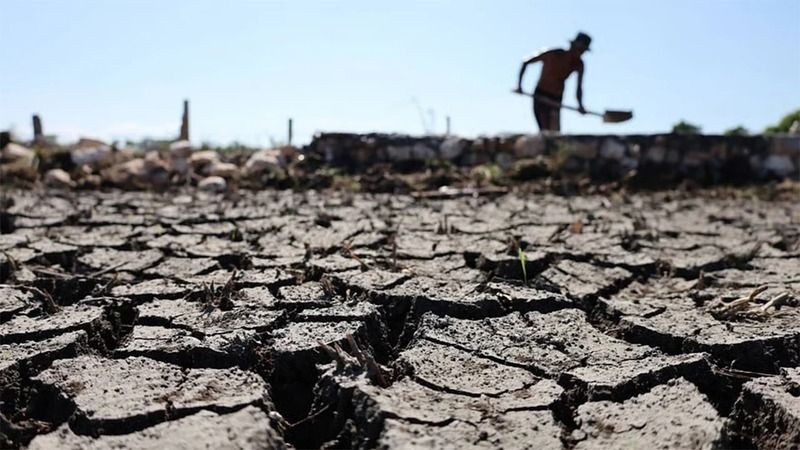
Extremely powerful El Niño is causing unusual weather patterns globally. Forecasts indicate heavy rainfall and floods in some areas, while others face drought and water scarcity. This is raising concerns about agricultural production and food security. At the same time, the European Union’s climate monitoring agency, Copernicus, has stated that 2026 could be the second warmest year on record.
According to the agency’s report, published on November 6, the global average temperature from January to October this year has been the second highest on record. October was the warmest October in history. The global average surface temperature for that month was 15.35 degrees Celsius, which is 0.90 degrees higher than the average for October from 1991 to 2020.
According to Copernicus’s forecast, there is an almost 80 percent chance that 2026 will be the second warmest year. However, there is also a possibility that it could surpass or equal the record warmth of 2024. Samantha Burgess, Deputy Director of Copernicus Climate Change Service, said that a very strong El Niño is adding even more heat to a climate already warmed by human activities.
El Niño is a warm phase of a natural climate cycle. During this period, the water temperature in the tropical Pacific Ocean rises above normal. Its influence alters the normal patterns of rainfall and temperature in various regions worldwide. Some regions may experience drought, while others face increased risks of heavy rainfall and floods. Experts fear that the current El Niño’s effects could continue into 2027, and that year is at risk of becoming the world’s warmest.
Due to the risk of floods from El Niño, the Peruvian government has declared a state of emergency in extensive areas of the country. A government decree issued on November 3 brought high-risk districts in various regions under emergency status. Earlier, Bolivia also declared a national state of emergency to cope with the impact of similar meteorological conditions.
During El Niño, various regions in Latin America may experience heavy rainfall. Already, several areas in Peru’s northern Tumbes and Piura regions have been inundated by heavy rains. According to authorities, over 9 million people in the country—almost one-third of the total population—are at high risk of floods and landslides.
Meanwhile, concerns have also arisen regarding hydropower generation in several Asian regions due to the feared drought caused by El Niño’s influence. If temperatures rise and rainfall decreases, water scarcity could affect reservoirs of hydropower plants.
However, Sri Lanka’s state-owned power utility has temporarily withdrawn its proposal to increase electricity prices. Given the forecast of heavy rainfall due to El Niño and sufficient water reserves in hydropower reservoirs, the utility is no longer seeking the proposed price hike for the last three months of 2026.
However, officials have stated that the country could face a severe drought in the first half of 2027. In that scenario, dependence on more expensive and polluting thermal power might have to increase. Currently, approximately 70 percent of Sri Lanka’s total electricity demand is met by renewable energy, primarily hydropower and solar power. The remaining demand is met by coal and diesel.
On the other hand, the Philippines has announced an allocation of over 980 million dollars for its agricultural sector to combat the effects of El Niño. This fund will be spent under the ‘El Niño Response Plan’ to mitigate climate-related risks in the country’s agricultural production.
According to government statistics, approximately 8 percent of the Philippines’ Gross Domestic Product comes from the agricultural sector. One in every four people in the country is employed in this sector. The country’s agriculture department stated that due to El Niño and rising fuel and fertilizer prices caused by the Iran war, rice production decreased by 18 percent in the three months from July to September. Furthermore, the country’s meteorological department has forecast less than normal to significantly less rainfall for November.
Experts fear that both scenarios—excessive rainfall in some areas and drought in others—due to El Niño could disrupt agricultural production. Besides crops and food stocks being destroyed by floods, damage to communication systems could also create problems in food supply to markets. Maximo Torero, Chief Economist of the United Nations Food and Agriculture Organization (FAO), has warned that its impact on food prices could be felt even before harvests. Especially for low-income people, even a slight increase in food prices can create a major crisis.
Source – AFP

