
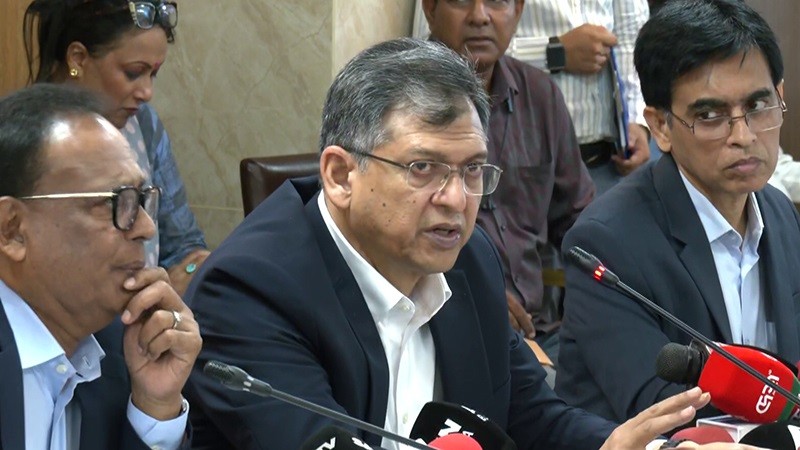
Home Minister Salahuddin Ahmed has stated that the ‘Cyber Security (Amendment) Act, 2026’ will in no way become an oppressive law, and the government is maximally vigilant to ensure that no journalist or media outlet is harmed by its misuse.
He said that the final shape of the law would be given after gathering opinions from people of various professions and through extensive discussions.
He made these remarks on Monday (September 28) at a press briefing following a consultation meeting held at the conference room of the Ministry of Information and Broadcasting at the Bangladesh Secretariat, concerning the draft of the ‘Cyber Security (Amendment) Act, 2026’ with print and electronic media stakeholders.
The Home Minister said that the draft bill prepared for the amendment of the Cyber Security Act has already been presented to the cabinet. As per the cabinet’s directive, extensive discussions and consultations are being held with all relevant stakeholders, including IT experts working in cyberspace.
To prevent the law from becoming an oppressive tool, the draft has been published on the website, inviting opinions from people from all walks of life. He also mentioned that various institutions, human rights organizations, students, and cyberspace users have already provided their feedback, which the government has compiled.
The Home Minister stated that this was the government’s second meeting with editors, representatives of prominent print and electronic media, distinguished journalists, newspaper organizations, and representatives of various professional journalists’ organizations. In the first meeting, held on September 10 with editors, it was decided to provide written opinions in subsequent meetings. In this meeting, many presented summaries of their opinions and promised to submit written recommendations.
At the meeting, Mahbub Anam, editor of The Daily Star, proposed a more extended and intensive discussion with media and cyber experts. His proposal focused on ensuring that the media is not harmed or victimized in any way, and that necessary ‘saving clauses’ or protective provisions are included in the law.
The Home Minister said that the government has accepted this proposal. He explicitly stated, “We did not and do not intend to target the media with this law. Our primary goal is to ensure that no journalist becomes a victim of the misuse of this law.”
He further stated that another important proposal for the protection of journalists was brought up at the meeting: making prior court approval mandatory before taking legal action or arresting any journalist. The government considers this proposal appropriate and reasonable. It will be incorporated into the bill after formal recommendations are received from stakeholders within the next 15 days.
Additionally, he announced that a provision would be made to set a specific time limit for the disposal of cases or appeals, so that no one remains in limbo indefinitely.
The Chief Information Officer (PIO) has been assigned as the focal point for coordinating the process of finalizing the draft law. The Ministry of Post, Telecommunications and Information Technology and the Ministry of Information and Broadcasting will jointly coordinate the entire process.
Representatives from the Editors’ Council, the Electronic Media Association, and a special panel of cyber experts formed by the IT Ministry will participate in this. They will provide specific recommendations within the next 7 to 15 days. Following this, the concerned ministries and committee members will meet after 15 days to make further decisions.
The Home Minister informed that the revised draft, based on stakeholders’ recommendations, will be published on the website again before being sent to the cabinet. This will provide the general public and relevant stakeholders another opportunity to provide feedback. Acceptable opinions will be incorporated into the draft.
Subsequently, as per procedure, after final review in an inter-ministerial meeting, the bill will be submitted for cabinet approval. If the cabinet approves it, it will be presented as a bill in the National Parliament.
However, the Minister stated that even after its submission to parliament, the bill would not be hastily passed. The final decision will be made after considering discussions from both government and opposition parties in parliament, as well as opinions gathered from various seminars and symposiums held outside parliament.
Highlighting the objective of the ‘Cyber Security (Amendment) Act, 2026,’ Salahuddin Ahmed said that the government aims to enact a balanced law that will protect the country, society, and particularly the youth, from various cybercrimes and rapidly spreading criminal activities in cyberspace.
He also stated that an internationally harmonized law would be enacted, taking into consideration social and religious harmony, family ties, and indigenous culture.

