
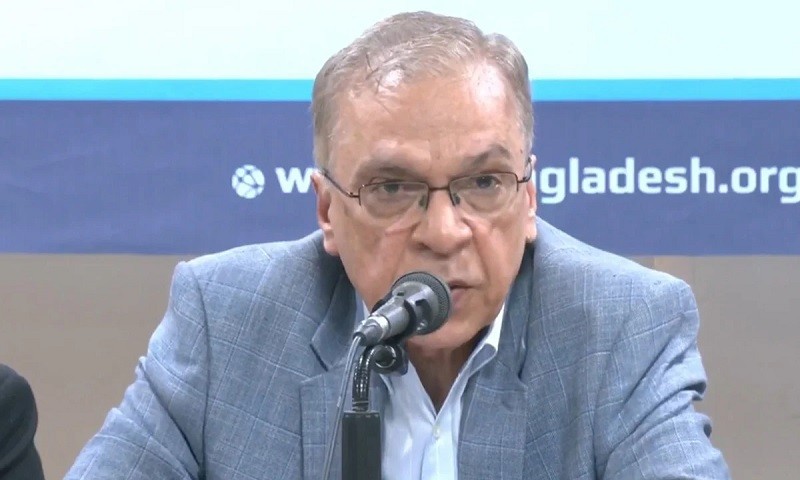
Dr. Iftekharuzzaman, Executive Director of Transparency International Bangladesh (TIB), has stated that the mandate of the July uprising is at risk due to a lack of coordination between the Election Commission (EC) and the current interim government.
According to him, the lack of coordination between the EC and the government, legal ambiguities, and political pressure have become major obstacles to realizing the public aspirations for state reform that emerged through the July uprising.
He noted that ill-considered decisions, ambiguous legal interpretations, and a lack of institutional capacity in organizing the historically significant referendum are creating confusion among the public, which in turn is questioning the credibility of the entire process.
Dr. Iftekharuzzaman stated that the Election Commission is showing visible weakness in effectively exercising its vested constitutional responsibilities and powers. Under pressure from political parties, the Commission is often failing to take a firm stand. Despite widespread violations of the code of conduct and irregularities occurring both online and offline, the EC is unable to take effective measures.
He further added that a section of the administration and law enforcement agencies is also playing an inactive role in ensuring a neutral and influence-free environment. Additionally, incidents of harassment and threats against field-level data collectors are concerning.
The TIB Executive Director commented that controlling misinformation, hate speech, and personal attacks on digital platforms has become a major challenge for the EC. He said that global technology companies like Google and Meta are not playing an effective role in removing content that violates their own policies.
According to Iftekharuzzaman, business interests or ‘money dependency’ play a significant role for these companies. The lack of adequate and institutional communication or coordination with the Election Commission means that necessary lessons for future electoral processes are not being learned.
He also expressed deep concern regarding the government’s role in the referendum issue. In his words, due to the conflicting stances of influential political parties, the government has been in a vacillating position from the outset. The ordinance issued in an attempt to appease both sides has further obscured the question and purpose of the referendum.
He stated that the decision to hold the election and the referendum on the same day has made the matter unnecessarily complicated. He highlighted the biggest legal deviation as the Election Commission’s consideration of a referendum as synonymous with an ‘election.’ However, according to the Representation of the People Order (RPO), a referendum is by no means synonymous with an election, as no vote is cast here for any individual or constituency.
Dr. Iftekharuzzaman commented that although government employees are legally under the Election Commission after the schedule announcement, the government has created controversy by instructing them to campaign in favor of the referendum. According to him, the EC’s consent should have been obtained before taking such a decision.
He said that the EC, in this regard, has played a virtually inactive role, relying on a misinterpretation of the law. Furthermore, serious questions remain about imposing decisions on various institutions, including banks and NGOs, as well as the transparency of financing and expenditure in conducting the referendum.
Dr. Iftekharuzzaman further stated that the core foundation of the referendum should be the ‘July Charter’ emanating from the July uprising. He believes it is crucial to utilize this historic opportunity to implement fundamental constitutional reforms.
On behalf of TIB, he put forward several specific reform proposals. These include—amending Article 20(2) of the Constitution to criminalize abuse of power, granting constitutional status to the Anti-Corruption Commission, increasing women’s representation in parliament to 100 seats, and ensuring at least 33 percent female candidate nominations.
Additionally, he demanded amending Article 70 of the Constitution to allow Members of Parliament to vote against their own party on matters other than money bills and no-confidence motions, and to appoint opposition members to the positions of Deputy Speaker and chairpersons of important parliamentary committees.
Dr. Iftekharuzzaman further stated that there is no alternative but to ensure the full independence of all state institutions, including the judiciary, to establish accountable democracy and good governance as per the core expectations of the July uprising. He called upon the countrymen to explicitly say ‘no’ to corruption and ‘yes’ to state reform in light of the July Charter.

