
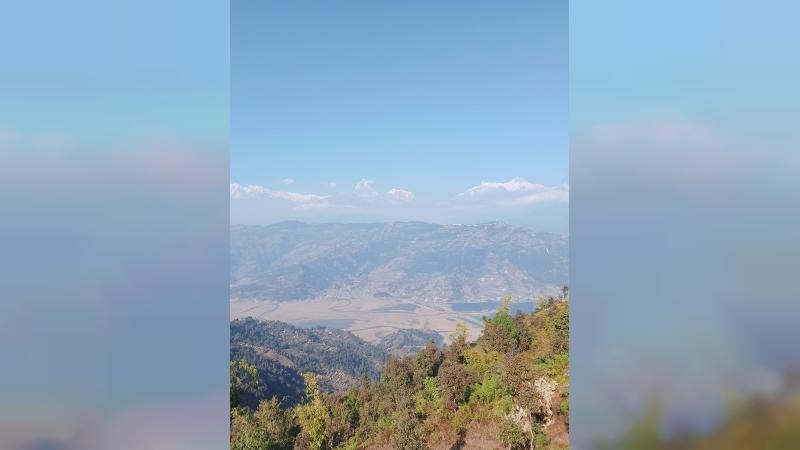
Masudur Rahman, back from Nepal: The Himalayan nation of Nepal has transformed into a living battlefield of climate change. Despite Nepal’s contribution to global greenhouse gas emissions being a mere 0.1 percent, its geographical location has made it one of the world’s most climate-vulnerable nations. Rapidly melting glaciers, irregular rainfall, and devastating landslides—all combined, Nepal’s nature stands at a critical juncture.
According to recent data, over the past four decades, the temperature in Nepal’s Himalayan region has increased by approximately 0.05°C per decade. As a result, nearly 25 percent of its glaciers were lost between 1980 and 2010. In the current reality of 2026, melting ice is revealing decades of accumulated waste and dead bodies, severely polluting the water sources of downstream mountain communities. Furthermore, the risk of untimely floods and Glacial Lake Outburst Floods (GLOFs) is now significantly higher than before. Beyond the environment, this also impacts Nepal’s economy. It is feared that by 2050, climate change could lead to a reduction of up to 2.2 percent in the country’s GDP.
To combat climate change, the Nepalese government and local communities have undertaken several commendable initiatives. Nepal has set targets for zero carbon emissions by 2045 and negative carbon emissions by 2050. Currently, Nepal is successfully protecting approximately 45 percent of its land as forest cover. Additionally, one of Asia’s first ‘Fish Sanctuaries’ has been declared in the West Karnali region, marking a milestone in aquatic biodiversity conservation. In 2024-25, approximately 85 tons of waste and a significant amount of human waste were removed from Mount Everest. The government has allocated a budget of over 100 crore Nepali Rupees for this initiative. In remote mountainous areas, farmers are being taught ‘climate-smart’ agricultural practices, which enable increased yields with less water.
Nepal is on track to graduate from ‘Least Developed Country’ (LDC) status in 2026. To ensure the sustainability of this transition, the country has significant plans. By implementing its Nationally Determined Contribution (NDC) 3.0, Nepal aims to ensure methane gas capture and sustainable waste management by 2035, in line with its new NDC. A target of approximately $18-20 billion in investment has been set for climate adaptation and mitigation, with efforts underway to secure these funds from international climate finance. Plans to integrate environmental awareness into the national education curriculum are in their final stages.
Nepal cannot save the Himalayas by fighting alone. According to experts, several more specific steps are essential. These include: regional cooperation: joint agreements on river and glacier management must be made with other Himalayan nations (India, China, Bhutan). Infrastructural resilience: ‘Green Urban Planning’ must be implemented to prevent Nepal’s urbanization from engulfing agricultural land (with an estimated loss of another 205 sq km of arable land by 2026). Compensation and climate finance: more robust compensation should be demanded from developed countries through the ‘Loss and Damage’ fund.
Nepal’s Himalayas are not merely a country’s border; they are the water source for billions of people in South Asia. This environmental battle for Nepal is, in essence, a battle for existence. A concerted effort by the government and its people, alongside active support from the global community, can preserve the unique beauty and ecosystem of the Himalayas for the future.
Author: Masudur Rahman
Writer & Journalist
(Opinions expressed in the open column section are solely those of the author. BD24LIVE.com may not necessarily agree with the views expressed.)

