
Despite renewed diplomatic efforts to halt the ongoing US-Israel and Iran conflict in the Middle East, the real situation is becoming increasingly complex. US President Donald Trump has expressed optimism about a potential deal with Iran while also keeping military options open. Qatari news outlet Al Jazeera reported this information.
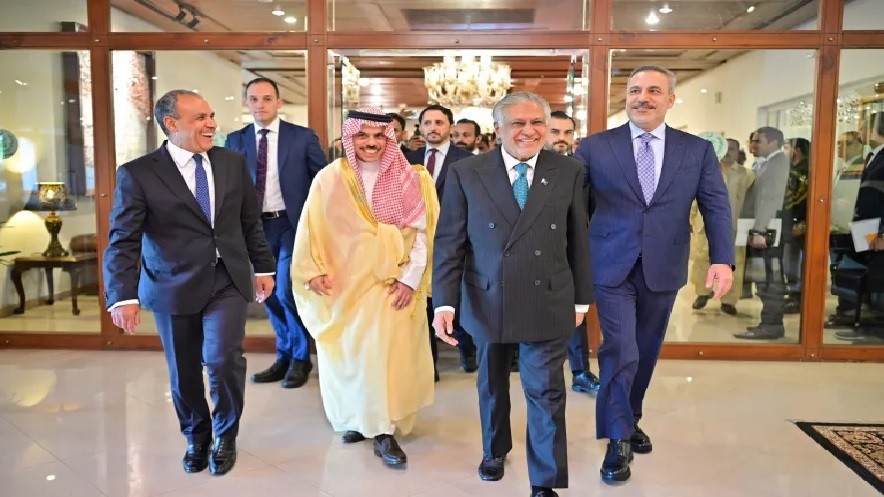
Recently, the foreign ministers of Pakistan, Turkey, Saudi Arabia, and Egypt met in Islamabad. Representatives from the four countries initiated efforts to establish a coordinated diplomatic framework to commence dialogue between the United States and Iran.
Pakistan’s Deputy Prime Minister and Foreign Minister, Ishaq Dar, stated that both Washington and Tehran have expressed confidence in Islamabad, and there are plans to organize direct talks soon. To this end, a high-level committee comprising representatives from the four nations has been formed to outline the discussion framework.
Turkish Foreign Minister Hakan Fidan, Egypt’s Badr Abdelatty, and Saudi Arabia’s Prince Faisal bin Farhan Al Saud participated in the meeting.
Trump’s Dual Stance
Hours after the meeting, Trump stated in an interview, “A deal with Iran could happen very soon.” However, he did not rule out the possibility of seizing Kharg Island, a crucial oil export hub for Iran.
He further revealed that indirect discussions are underway through Pakistan and reiterated a warning of attacks on Iran’s energy sector if a deal is not reached by April 6.
Diplomatic Progress, But ‘Baby Steps’
According to analysts, the Islamabad meeting represents the first organized peace initiative from the Muslim world. Both Pakistan and Turkey, being neighbors of Iran, have credibility as mediators.
However, in the words of former diplomats and analysts, this is still in its “baby steps” or early stages, as the necessary trust to halt the war has not yet been established.
Four potential steps have been identified for this initiative:
Confidence-building measures
Ceasefire negotiations
Direct dialogue on complex issues
Final settlement
US and Iran Positions Far Apart
According to analysts, the biggest obstacle is the fundamental difference in demands from both sides.
Among the US proposals are:
A one-month ceasefire
Transfer of highly enriched uranium
Limiting nuclear activities
Control over missile programs
Ending support for regional allies
On the other hand, Iran demands:
Cessation of aggression
Reparations
Guarantees against future attacks
Halting attacks against allies
Recognition of sovereignty over the Strait of Hormuz
Iranian Foreign Ministry spokesperson Esmail Baghali rejected the US proposals as “unrealistic and excessive” and expressed skepticism about Islamabad’s initiative.
Support from China and the UN
China has supported Pakistan’s diplomatic initiative. The country’s Foreign Minister, Wang Yi, views this initiative positively.
Additionally, Antonio Guterres has also expressed support for the peace efforts.
Military Tensions Continue
Despite ongoing diplomatic efforts, military preparations have not ceased. The US has already deployed thousands of troops, including a large fleet with the naval warship USS Tripoli.
Meanwhile, Israel has continued its attacks on Iran. Israel’s Ambassador to the UN, Danny Danon, stated that operations would continue until Iran’s nuclear and missile capabilities are destroyed.
Strait of Hormuz and the Global Economy
Iran recently allowed 20 Pakistani ships to transit through the Strait of Hormuz, which is seen as an important confidence-building measure.
However, the effective closure of the strait has had a major impact on the global energy market. According to the International Energy Agency, this is one of the largest oil crises in history. Brent crude prices have already surpassed $116.
Major Obstacles: Lack of Trust and Israel’s Role
According to analysts, the biggest challenge is Iran’s deep distrust. Tehran fears that military attacks might be prepared under the guise of diplomatic discussions.
Furthermore, analysts have warned that Israel’s continued attacks could jeopardize this diplomatic process.
Overall, while this Pakistan-led initiative has opened an important diplomatic path, it remains fraught with uncertainty.
Analysts warn that if an immediate ceasefire is not established, the situation could become even more dire and escalate into a global crisis.

