
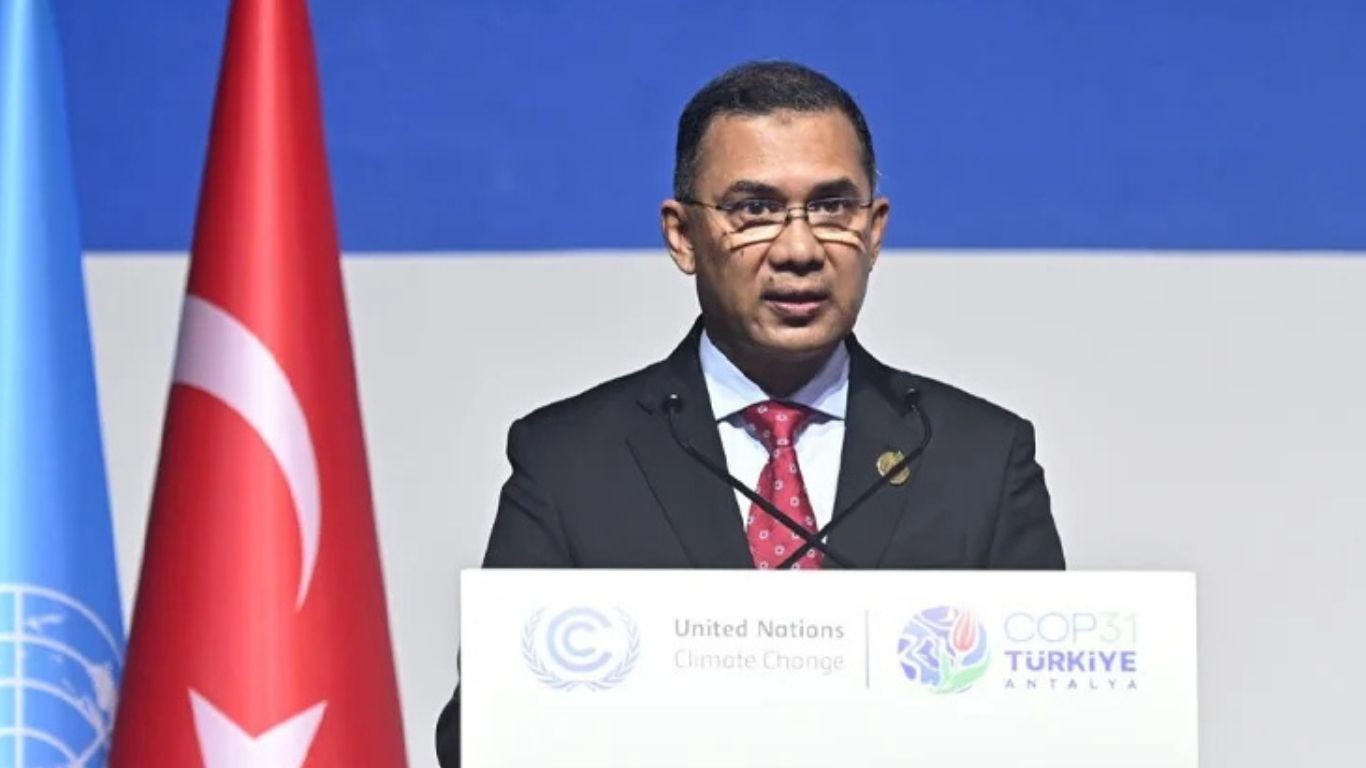
Prime Minister Tarique Rahman has called for grants instead of new loans for vulnerable developing countries to combat the damage caused by climate change. He also put forward a five-point proposal, including allocating at least 50% of international climate finance to adaptation efforts and ensuring a just energy transition.
The Prime Minister presented these proposals in his address at the high-level session of COP-31, the UN Climate Change Conference, held in Antalya, Turkey, on Thursday (November 12).
Tarique Rahman stated that developing countries are facing extensive damages due to climate change, while also experiencing increasing pressure from debt repayments. In this situation, climate-vulnerable countries require reliable financial assistance, access to modern technology, and adequate support for adaptation activities.
The Prime Minister noted that Bangladesh’s contribution to global greenhouse gas emissions is less than 0.5%, yet it remains one of the most climate-vulnerable nations. Considering this reality, the government is committed to building a climate-resilient and sustainable economy worth one trillion dollars.
He emphasized that, guided by the ‘Bangladesh First’ philosophy, the government aims to advance economic growth and environmental conservation as complementary goals.
Hovering over various government initiatives that balance industrialization with environmental preservation, Tarique Rahman stated that Bangladesh aims to meet 20% of its electricity demand from renewable energy by 2030. Initiatives include generating 4,000 megawatts of solar power through special tax incentives. Additionally, generating energy from waste is being actively encouraged.
Highlighting Bangladesh’s progress in green industrialization, the Prime Minister mentioned that nearly 300 garment factories in the country have received LEED certification. Efforts are underway to expand eco-friendly transportation systems, including electric vehicles. Alongside promoting environmentally friendly products like jute bags, work is also ongoing to create a national framework for carbon trading.
As part of its environmental conservation and climate adaptation plans, he announced a scheme to plant 250 million trees over the next five years. Furthermore, initiatives have been taken to implement master plans for the Padma and Teesta barrages and to excavate 20,000 kilometers of rivers and canals. The objectives of these activities are water conservation, flood risk reduction, wetland revitalization, and increasing groundwater levels. Work is also underway to restore mangrove forests on reclaimed coastal lands.
**Five-Point Proposal for Climate Finance**
Describing the current international climate finance system as inadequate, the Prime Minister said that it does not properly reflect the needs and priorities of developing countries. The additional pressure of debt repayment, alongside climate-induced damages, further exacerbates the crisis in these nations.
To address this situation, he called for five actions based on the principle of ‘common but differentiated responsibilities and respective capabilities’.
In his first proposal, the Prime Minister advocated for allocating at least 50% of international climate finance to adaptation activities, according to each country’s specific priorities. He also urged continued support for initiatives aimed at reducing greenhouse gas emissions.
The second proposal called for the introduction of special debt relief facilities for climate-vulnerable countries. This includes climate-resilient debt streams and ‘debt-for-climate swaps’ or arrangements for debt forgiveness in exchange for climate protection.
Thirdly, he urged ensuring fair access for developing countries to environmentally friendly climate technologies and providing necessary support for technology transfer.
In his fourth proposal, the Prime Minister emphasized increasing the use of renewable energy through affordable financing, skill development, and a just energy transition.
Fifthly, he proposed adopting the ‘Belem-Antalya Action Mechanism’ for a just energy transition at the COP-31 conference. He highlighted just finance and trade as the core foundations of this initiative.
**Call for Ensuring Women and Youth Participation**
The Prime Minister also emphasized ensuring the active participation of women and youth in climate action. He stated that dignified green employment opportunities must be created in this sector. Simultaneously, it is crucial to reduce global greenhouse gas emissions worldwide to achieve the goal of limiting global warming to 1.5 degrees Celsius.
At the beginning of his speech, Tarique Rahman thanked the Turkish government for hosting COP-31. He also expressed gratitude to Australia for leading the conference’s discussion process.
The Prime Minister stated that Bangladesh expects meaningful, balanced, and ambitious outcomes from COP-31. In particular, the interests of countries most vulnerable to climate change should be reflected in the conference’s decisions.
He concluded by saying that promises alone are not enough; they must be implemented. Global solidarity must be strengthened to collectively build a sustainable future.

