
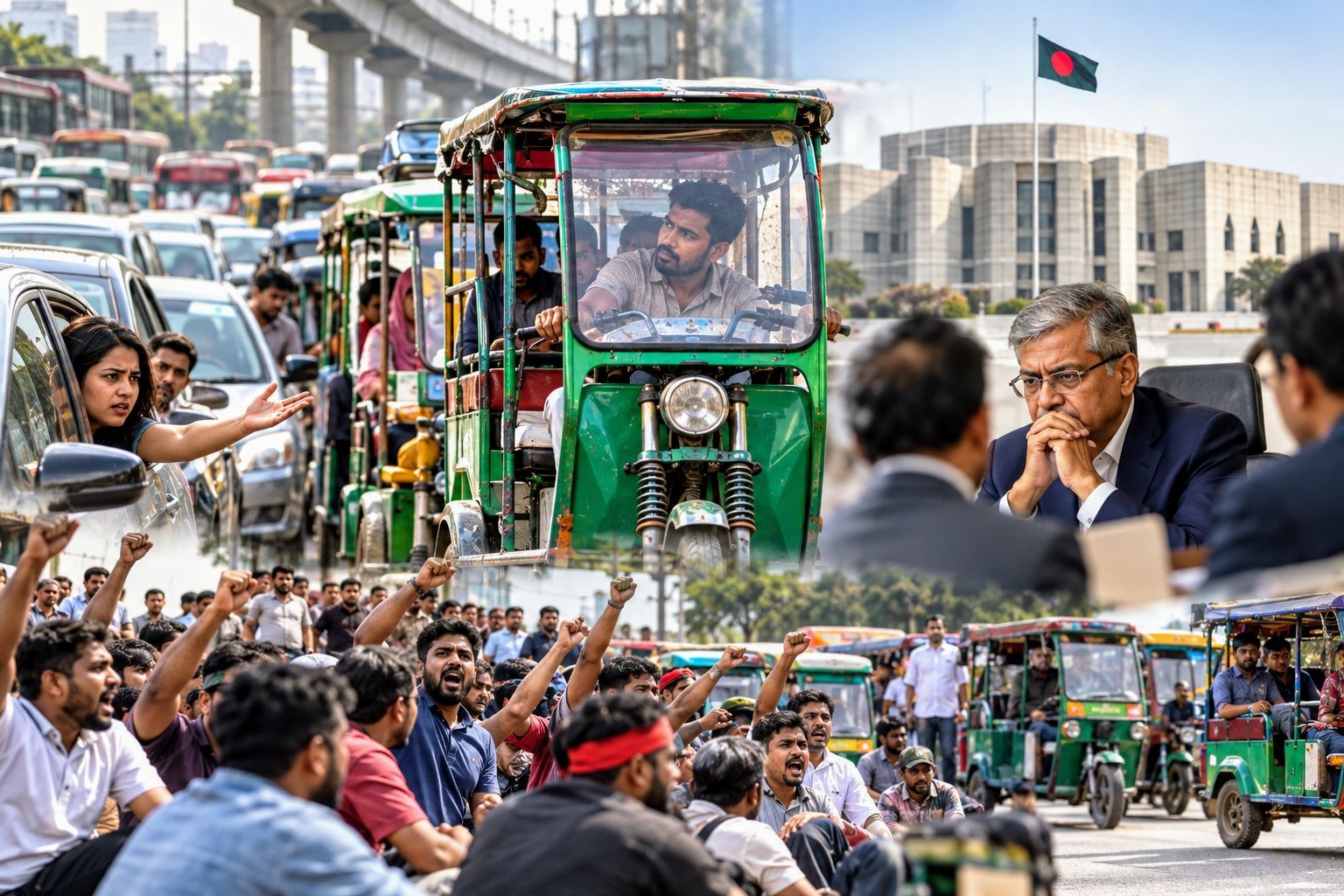
Amirul Islam: There is no end to the complaints about battery-run auto-rickshaws on the streets of the capital. Reckless driving, disregard for traffic laws, arbitrary U-turns, encroaching on main roads, and the risk of accidents — all combine to make this vehicle a source of irritation for a segment of city dwellers. Yet, despite so many complaints, the government is not moving towards a complete ban on auto-rickshaws. Instead, it is talking about allowing their controlled operation under a policy framework.
Adding a new dimension to this situation is the recent movement by auto-rickshaw drivers. Following thousands of drivers blocking roads in the capital, issuing a 48-hour ultimatum, and threatening tougher action, the question has become even more prominent: Why is the government lenient towards auto-rickshaws despite public dissatisfaction?
Thousands of Drivers on the Streets
On October 5, thousands of battery-run auto-rickshaw drivers gathered in front of the National Press Club in the capital. At one point, they blocked the road, halting traffic in the area and causing severe congestion nearby.
The protesters allege that battery-run auto-rickshaws are being seized and impounded in various areas, drivers are being fined, and electricity connections to charging garages are being disconnected.
Their demands include issuing road permits for auto-rickshaws, providing training and licenses for drivers, restoring electricity connections to charging garages, and stopping seizures and harassment.
Subsequently, the protesters issued a 48-hour ultimatum to the government. They also warned of more stringent programs if their demands were not met.
This means that the issue of battery-run auto-rickshaws is no longer confined to transport management alone. It has simultaneously become an issue of labor, livelihood, and street protests.
Government’s Message After the Protest
The most discussed aspect of this sequence of events is the timing.
On October 6, the day after the large-scale protest and ultimatum by auto-rickshaw drivers on October 5, the government once again announced that initiatives are underway to bring battery-run auto-rickshaws under a policy framework rather than banning them completely.
Sheikh Rabiul Alam, Minister for Road, Rail, and Water Transport, stated that these vehicles must be controlled in main roads and important areas. At the same time, the livelihood of people who have been involved in this profession for a long time must also be considered.
However, there is no direct opportunity to conclude that the government took such a stance solely because of the protest. This is because initiatives to bring auto-rickshaws under policy were already underway. But it is difficult to deny the reality that thousands of drivers taking to the streets and threatening tougher action has created new pressure on the government.
People are Annoyed, Yet People are Also Passengers
This is where the biggest contradiction regarding auto-rickshaws lies.
Many residents of the capital are annoyed by the presence of battery-run auto-rickshaws on main roads. Complaints about untrained drivers, sudden lane changes, driving on the wrong side, disregard for traffic signals, and arbitrary passenger pick-up and drop-off have been long-standing.
However, the same people who are annoyed by traffic congestion caused by auto-rickshaws often become passengers of these very vehicles when needed.
For short distances in alleys, residential areas, or from home to bus stops, markets, or metro stations, auto-rickshaws are now an important mode of transport. Where buses or other public transport do not easily reach, alternatives are limited.
Consequently, the public’s position is not entirely black and white. The objection is primarily not to the existence of auto-rickshaws, but rather to their uncontrolled operation and the resulting chaos on the roads.
Livelihood Questions Arise with Strict Action
Perhaps the biggest reason for the government’s leniency is the reality of livelihood.
The steering wheel of an auto-rickshaw supports not just one driver’s family. A large informal economy has grown around it. Many people, including owners, garage operators, mechanics, battery and parts vendors, and charging business owners, are directly and indirectly involved in this sector.
Therefore, if the government were to ban these vehicles with a single decision, the impact would not only be on the roads but also on the income of a vast number of families.
The question of livelihood was most strongly highlighted in the recent protest. The drivers’ position is that if auto-rickshaws are to be banned, alternative employment opportunities must also be provided for them.
Herein lies the difficulty of the government’s decision.
There is Also Pressure from Protests
The recent actions by auto-rickshaw drivers have made another thing clear: people associated with this sector are now organized.
They can organize programs involving thousands of people on important roads in the capital. They can block roads. They can issue ultimatums to the government and threaten tougher movements.
Therefore, if the government suddenly takes a strict stance, merely banning auto-rickshaws will not solve the problem; there will also be a risk of new labor unrest and street instability.
Thus, the calculation for the administration is complex: auto-rickshaws must be controlled, but in such a way that a large number of people do not simultaneously take to the streets.
Where are the Alternative Transports?
Against the demand to ban auto-rickshaws, there is another practical question: What is the alternative?
Buses do not cover all areas of Dhaka. The metro also does not reach every neighborhood. In many areas, rickshaws or battery-run auto-rickshaws are the easiest way to get from main roads to homes.
The government also has to consider where those passengers would go if auto-rickshaws are suddenly removed.
Therefore, instead of completely banning auto-rickshaws, the idea of allowing them to operate in designated areas and routes, keeping them off main roads, is gaining more importance.
The Government is Actually in a Dilemma
On one side, there is traffic congestion in the capital, road safety, and public resentment. On the other side, there is the need for affordable short-distance transport, the livelihood of a vast number of people, and the pressure from organized drivers’ protests.
The government stands amidst these three realities.
A strict ban could create a crisis in employment and transport. Conversely, allowing them to operate without control could further increase chaos on the streets of the capital.
This is probably why terms like ‘control,’ ‘policy,’ ‘registration,’ and ‘designated routes’ are heard more often in government statements than ‘prohibition.’
Leniency or Recognition of Reality?
So, can the government’s stance towards auto-rickshaws be called mere leniency?
In reality, it could be a combined calculation of political, economic, and transport management factors. Because when a vehicle becomes a source of livelihood for millions and simultaneously a daily means of transport for a vast number of people, it is not easy to simply remove it by administrative order.
But this is where the government’s biggest test lies.
If auto-rickshaws are allowed to operate without control due to protest pressure or livelihood arguments, the general city dwellers will pay the price. Conversely, if they are strictly banned without alternative arrangements, drivers and passengers will pay the price.
Therefore, the solution is neither a ban nor unrestricted operation. What is needed is mandatory registration, visible number plates, driver training and licenses, designated speed limits, quality vehicles, specific routes, and strict enforcement of restrictions on main road usage.
Ultimately, the question is not whether auto-rickshaws will exist or not. The question is whether the government can bring this vast sector under discipline, minimizing public suffering while considering the reality of livelihoods.

