
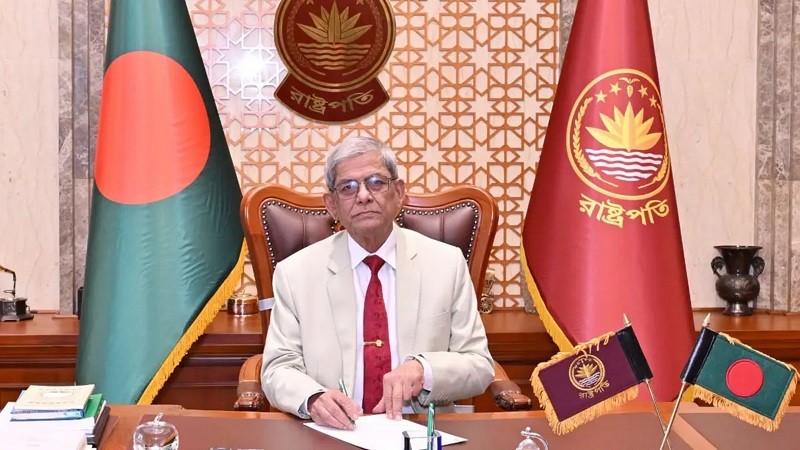
President Mirza Fakhrul Islam Alamgir has announced that the current government is in the process of formulating a comprehensive ‘National Tourism Master Plan’ that will incorporate 1,498 tourist attractions across the country.
He made this statement in a message delivered on Saturday (September 26) on the occasion of ‘World Tourism Day 2026’, which falls on Sunday (September 27).
Mirza Fakhrul Islam Alamgir stated that the current government is committed to advancing the tourism sector in a long-term, sustainable, and planned manner. To achieve this goal, work is ongoing to formulate a coordinated ‘National Tourism Master Plan’ incorporating 1,498 tourist attractions across the country. Initiatives have also been taken to create tourism facilities based on local traditions and culture, considering the tourism potential of each district.
The President expressed his delight that ‘World Tourism Day 2026’ is being celebrated in Bangladesh, as in other countries worldwide, under the initiative of the Ministry of Civil Aviation and Tourism.
He further elaborated that tourism is a highly promising sector in Bangladesh, a country rich in immense natural beauty. Bangladesh is a unique destination for tourists, offering Cox’s Bazar’s long sea beach, the Sundarbans’ vast mangrove forest, Sylhet’s tea gardens, Saint Martin’s Island, Bandarban’s Sajek Valley, Nilgiri, Nilachal, Rangamati’s Kaptai Lake, Jaflong’s hill waterfalls, Bagerhat’s Sixty Dome Mosque, vast water bodies of the Haor region, green hills, Buddhist monasteries, countless rivers, green crop fields, the immense beauty of six seasons, coupled with the warm hospitality of its people and its rich culture and heritage. The tourism sector acts as a powerful catalyst for the country’s economic and infrastructural development, job creation, and poverty alleviation.
Mirza Fakhrul Islam Alamgir noted that, in line with new innovations and technologies globally, the tourism sector is also constantly evolving. Digital technology and artificial intelligence are today transforming the structure, management, and service delivery of tourism worldwide – their impact is expanding everywhere, from travel planning, information access, transportation, and accommodation. In this context, I believe this year’s theme for the day, ‘Digital Transformation and Future Tourism in Artificial Intelligence,’ has become extremely timely and significant.
He mentioned that alongside updating the national tourism policy and constructing modern tourism training institutes, plans are being adopted for the development of eco-tourism and community tourism. If the government’s ongoing initiatives for the development of the information technology sector are implemented, the digital transformation of tourism will also be accelerated. Online booking, digital payments, and AI-based information services will make Bangladesh’s tourist destinations more accessible, safer, and attractive.
The President called upon all public and private stakeholders to collectively come forward to make the tourism industry technology-dependent through the integration of technology and artificial intelligence, and to develop Bangladesh as one of the world’s most attractive tourist destinations.
He concluded by saying, ‘Let the digital and sustainable transformation of the tourism industry, while preserving environmental balance and cultural heritage, be our collective commitment.’
Finally, in his message, the President wished overall success for all programs undertaken on the occasion of ‘World Tourism Day 2026’.

