
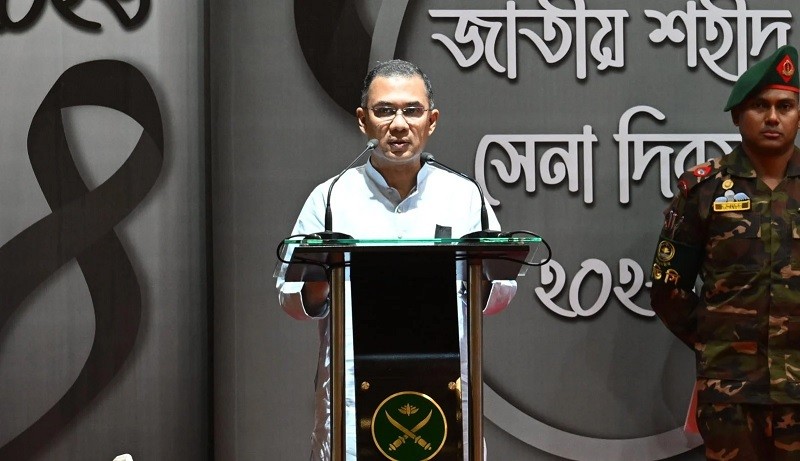
Prime Minister Tarique Rahman has stated that remembering the Pilkhana incident with state dignity is a national responsibility. He also added that if the events of February 25 and 26 are not accorded state recognition in history, future generations will not forgive us.
He made these remarks on Wednesday (February 25) evening at a discussion meeting held in Dhaka Cantonment, on the occasion of ‘National Martyred Army Day’.
The Prime Minister said, “On this waning afternoon of the holy month of Ramadan, I respectfully remember the brave martyrs of the Great War of Liberation, and all students and people who were martyred in the mass movements of the 90s and the mass uprising of ’24. I deeply remember the 74 brave martyrs, including 57 patriotic army officers, who were martyred in the barbaric massacre at Pilkhana on February 25 and 26, 2009. I pray for the salvation of their souls and express my deepest condolences to the bereaved families of the martyrs.”
He continued, “Today, February 25, is a bloody and sorrowful day in the history of the nation. When this day arrives, nature seems to fall silent again, burdened by memory and grief, and the screams of that terrifying moment float in the air. Our hearts are heavy with deep sorrow. This cruel event of February 25 and 26, 2009, created a deep wound in our national life, whose pain continues to flow even after all this time.”
“After a long 17 years since the incident, my voice becomes heavy today in this hallowed ground, associated with the martyrs. I am not present before you merely as a public representative, but as a member of an army family, like the child of a comrade. In that horrific incident of 2009, 74 lives were lost, including 57 brilliant and patriotic army officers. Each name tells a story of a family’s light being extinguished, a sorrowful chapter of losing a loved one, a history of a child becoming fatherless, an unfinished epic of a dream.”
Tarique Rahman said, “Immediately after my return to the country, standing by the graves of the martyred army officers in Banani Military Cemetery, I realized the unbearable struggle, immense sacrifices, and the excruciating pain of not receiving justice that you have endured for the past 17 years. I believe that remembering the Pilkhana incident with state dignity is our national responsibility. If the events of February 25 and 26 are not accorded state recognition in history, future generations will not forgive us. Therefore, in consultation with the army and yourselves, the current government will work to preserve the memory of February 25 and 26.”
The Prime Minister stated, “The roots of our border guard force are deeply embedded in the history of our independence. On March 27, 1971, when Shaheed President Ziaur Rahman declared independence from the Kalurghat radio station in Chittagong, members of the then EPR, alongside the army, were on duty at the radio station, bearing witness to a glorious history and making unforgettable contributions from the very beginning of the Great War of Liberation. Subsequently, Shaheed President Ziaur Rahman placed special emphasis on strengthening the border guard force and initiated infrastructural development and necessary reforms.”
“The number of eligible and talented officers seconded from the army was increased. The biggest event in the history of this force occurred in 1978 with its reorganization in a military manner. The previous wings were transformed into battalions. Two new battalions were added, expanding the force’s structure.”
Tarique Rahman further said, “After a long struggle, a government elected by the people is now running the country. On the issue of the country, we will make our border force even more modern and integrated. Our members will perform their duties at the border with patriotism and professional excellence. The army has a glorious history in Bangladesh’s War of Independence and post-independence nation-building. The army is a symbol of our sovereignty. I believe that this tragic Pilkhana incident was an attempt to undermine our sovereignty. The sequence of events in Pilkhana exposed weaknesses in our national security framework. Therefore, it is necessary to modernize, update, and strengthen our national security framework in line with global standards. Our government will work towards this goal. Simultaneously, we reiterate our commitment to establish long-term protective measures for the welfare of the martyrs’ families, including education, medical treatment, and rehabilitation for their children.”

