
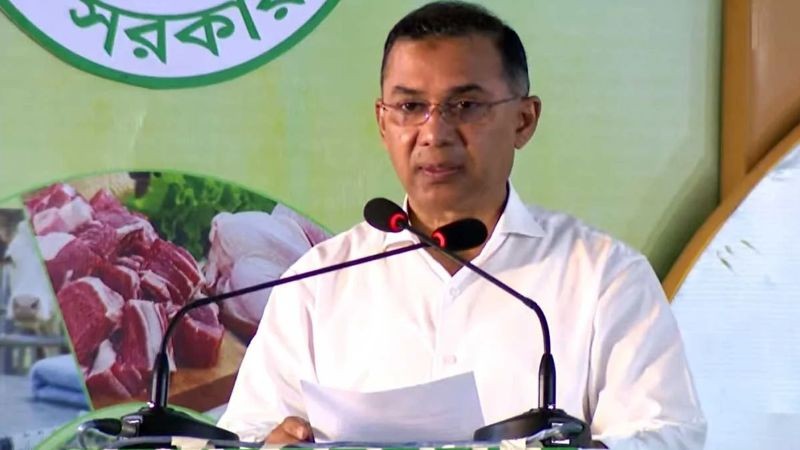
Prime Minister Tareque Rahman announced that the government is committed to continuing all forms of policy and financial support for the development and expansion of the livestock sector. He stated that the government is prioritizing the transformation of the livestock sector into a modern, science-based, production-oriented, and export-driven industry.
He made these remarks as the chief guest at the ‘National Livestock Week 2026’ event, held on Thursday (November 26) morning at the old trade fair ground in Sher-e-Bangla Nagar, Dhaka. The event was organized by the Ministry of Fisheries and Livestock and the Department of Livestock Services.
The Prime Minister stated that agriculture, fisheries, and livestock are the lifeblood of the rural economy. The livestock sector plays a crucial role in meeting people’s nutritional needs, creating employment, alleviating poverty, and strengthening the rural economy. He added that a self-reliant and prosperous economy can be built by meeting nutritional demands through domestic production and transforming that production into an industry.
He mentioned that currently, 56 percent of the animal protein consumed by the country’s population comes from milk, meat, and eggs. The production of animal protein is vital not only for ensuring nutritional security but also for achieving economic self-sufficiency. In the current fiscal year, the livestock sector’s contribution to GDP at constant prices is 1.81 percent, with a growth rate of 3.30 percent. Its contribution to agricultural GDP stands at 16.56 percent.
Tareque Rahman informed that from March to August 2026, the livestock sector generated an export income of 104.64 lakh US dollars over six months. To enhance productivity in this sector, emphasis is being placed on the use of modern technology, rearing improved breeds of animals and birds, artificial insemination, vaccination, disease prevention, advanced feed management, and farm waste management.
He stated that Bangladesh has for the first time successfully exported ‘hatching eggs’ or fertile eggs capable of producing chicks, on a commercial basis. In the short term, there are opportunities to increase exports of leather products, animal products and by-products, and approved processed goods. In the long term, there is significant potential for expanding the market for internationally standardized halal meat, dairy products, and poultry products.
Highlighting the contribution of the poultry sector, the Prime Minister noted that there are over two lakh poultry farms across the country, operating at both commercial and marginal levels. These farms produce approximately 6.88 crore eggs daily. Around 60 lakh people are directly and indirectly involved in this sector, 40 percent of whom are women. Private investment in the poultry sector amounts to approximately BDT 50,000 crore.
He further added that around 15 lakh marginal farmers in the country raise livestock for their livelihood. Ensuring their veterinary care is a crucial responsibility of the government. The Livestock Research Institute currently produces vaccines for 17 types of animal diseases. However, this is not sufficient, which is why the government has undertaken an initiative to establish a modern vaccine production plant.
Referring to the potential for buffalo rearing in coastal areas and the haor regions of Sylhet and Sunamganj, the Prime Minister stated that there is an opportunity to allocate newly emerged char lands and government Khas land to farmers for their use through cooperative arrangements. He urged the Ministry of Fisheries and Livestock to coordinate with the Ministry of Land and relevant Deputy Commissioners to take initiatives in this regard.
The Prime Minister also spoke about the increasing trend of keeping pets and caged birds. He emphasized that just as humans have rights, the rights of animals and birds must not be neglected. Animals must be kept free from hunger, thirst, discomfort, pain, injury, disease, fear, and mental suffering, and be given the opportunity to express their normal behavior.
Highlighting the purpose of celebrating National Livestock Week, Tareque Rahman said that the event aims to present the challenges, potentials, and successes of the livestock sector to the public. He affirmed that farmers are the main driving force of this sector, and the government is committed to ensuring their training, easy access to credit, advanced technology, fair prices, and necessary government assistance.

