
The Election Commission (EC) has planned to hold Union Parishad (UP) elections across the country in five phases. The first phase alone is scheduled to cover 1,026 unions across 131 upazilas. Election Commissioner Brigadier General (retd) Abul Fazl Md. Sanaullah stated that the list detailing which union will have elections and when will be published on the EC website by next Thursday.
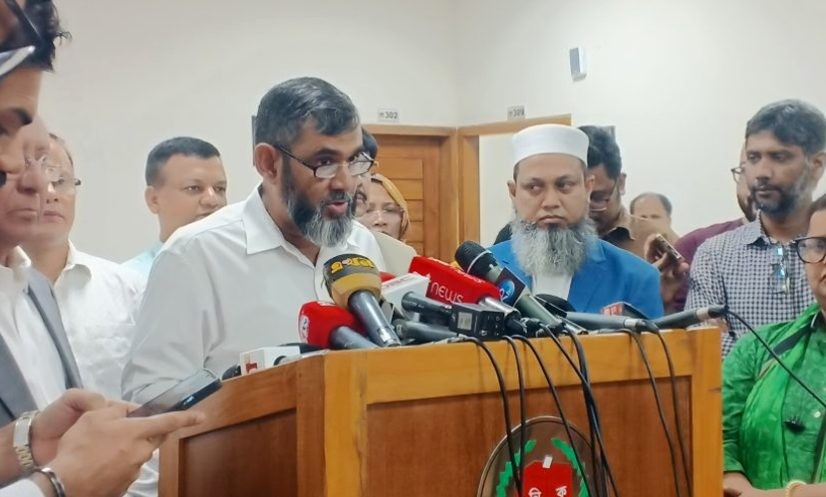
He made these remarks to journalists after a commission meeting at the Election Commission building on Monday (November 16).
He mentioned that the number of unions in the fifth phase has intentionally been kept low. This is to accommodate any unions whose elections are currently stalled due to legal complications or other reasons, allowing them to be adjusted into this phase later.
Outlining the planned number of elections for the five phases, he stated that the first phase would see elections in 1,026 unions across 131 upazilas. The second phase is planned for 1,113 unions in 129 upazilas, the third for 1,002 unions in 118 upazilas, the fourth for 793 unions in 93 upazilas, and the fifth for 356 unions in 37 upazilas.
He added, “These are our planned phases and numbers, and the specific names will be made known to everyone through the website next Thursday.”
Regarding dialogues with political parties in December, he said there are plans to conclude these dialogues before December 10. The Commission intends to hold similar discussions with political parties concerning local government elections, just as they did prior to the national elections.
Regarding the schedule for the first phase of elections, Sanaullah stated, “Assume that for the first phase, we have announced January 21, and district election officers will declare the exact dates within a plus-minus 50-day window from that date.”
In response to a question about whether the country’s law and order situation or political climate would affect local government elections, Sanaullah said, “We do not believe it will have any impact on local government elections. Local government elections, in fact, sometimes help maintain better law and order.”
When asked whether the upcoming elections would be held under existing laws, despite the Commission’s recommendations for electoral law amendments, Sanaullah stated that the elections would be conducted according to the law effective on the day the schedule is announced.
He clarified, “On the day the schedule is announced, the elections will be held according to the existing law on that specific day.”
When asked if political parties have demanded the deployment of the army in local government elections, Sanaullah said, “No such demand has come to the Commission yet. I don’t believe we have had any discussions with political parties regarding local government elections or received such demands until now. Discussions were held about national elections, and we will deploy forces wherever necessary for that.”
He assured that necessary measures would be taken to maintain a manageable law and order situation and ensure fair elections. The Election Commission will consider the adequacy and effectiveness of law enforcement agencies. Appropriate action will be taken based on whether the concerned forces can perform their duties effectively in an area and maintain an electoral environment.
Addressing the software complexity in NID smart card printing, he stated, “NID card printing is not stopped, smart card printing is not stopped. There has been a software issue with smart cards for the past four or five days, and its nature is currently being identified.”
He said that work is underway to resolve the software issue and it is expected to be fixed at any time. However, NID services for citizens are not suspended. If someone’s NID is approved, they can print it themselves from the website, laminate it, and use it.
He also informed that the Commission meeting discussed the non-renewal of the NID service contract and past audit objections. According to him, the contract has not been renewed even after its expiry, and an audit objection remains unresolved. The Commission is discussing how to proceed with the work under these circumstances.
Sanaullah stated, “Currently, we have some work being carried out without a contract. This is a long-standing issue, and we are trying to resolve it so that our cards can be printed at full scale.”
He also commented that NID service, being a national service, cannot be suspended.
Regarding the disposal of EVMs, he stated that Electronic Voting Machines (EVMs) will no longer be used in elections. The Commission meeting discussed the progress of the committee formed to determine how the stored EVMs will be disposed of.
Sanaullah said, “A committee was formed regarding the disposal of these EVMs. The Commission today received an update on the progress of that committee’s work.”
He informed that the work would commence from Gazipur, where the largest number of EVMs are stored. First, the quantity and condition of EVMs at various field levels will be assessed. Subsequently, measures for their disposal will be taken based on the committee’s recommendations.
He also mentioned that discussions or investigations concerning EVMs are ongoing with the Electoral System Reform Commission, the Investigation Commission, and the Anti-Corruption Commission. Decisions regarding EVMs will be made after these processes are concluded.
Highlighting that there could be multiple methods for EVM disposal, he said, “Disposal is not just one method. There are many ways we can dispose of them. We are looking for a solution. When our committee completes its work and provides recommendations, it will be clear which method we will adopt.”
**Workshop on NID Services**
The Election Commission will organize a workshop on November 18 to cover all aspects of national identity card services. The workshop will discuss how to make the service easier and more user-friendly, as well as address internal and external issues faced by service recipients and the Commission.
He stated, “Our objective is to conduct this workshop the day after tomorrow to explore ways to further simplify and make the national identity card service more user-friendly, and simultaneously resolve the problems we constantly face, both internally and externally.”

