
The United Nations’ International Court of Justice (ICJ) is set to deliver its verdict today, Thursday (November 19), on the genocide case filed against Myanmar concerning the military operations carried out against the Rohingyas in 2017. The judgment from the court, located in The Hague, Netherlands, has generated significant international interest.
The case, brought by the West African nation of Gambia, accuses Myanmar of violating the 1948 Genocide Convention. If proven, this could mark the first time in the history of the International Court of Justice that a state is held directly accountable for genocide.
According to a BBC report, Gambia filed the lawsuit in November 2019. Supported by the Organization of Islamic Cooperation (OIC), the case holds Myanmar as a state, not just its military, responsible for the genocide.
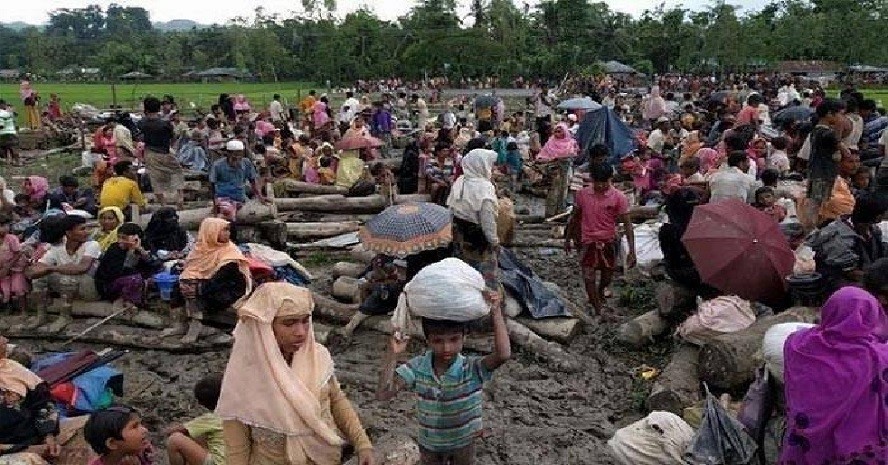
Following Myanmar’s military operations in Rakhine State in August and September 2017, over seven hundred thousand Rohingyas fled to Bangladesh to save their lives. Allegations of killing, torture, rape, and the burning of villages against the Rohingyas emerged from these operations. The UN Fact-Finding Mission also published detailed documentation of these incidents.
However, the central question before the court is whether these crimes committed against the Rohingyas were carried out with the specific intent to destroy them as a racial or ethnic group, either wholly or in part.
Myanmar authorities have denied the genocide allegations, claiming that the military operations in Rakhine were conducted in response to attacks by Rohingya armed groups.
Arsalan Suleman, the lawyer leading Gambia’s case against Myanmar, stated that if Gambia wins, it would be a profoundly significant historical event for international law. According to him, the verdict would strengthen the enforceability of the 1948 Genocide Convention and the concept of international accountability for state crimes.
Why This Case Is Important
Since the adoption of the 1948 Genocide Convention, individuals have been prosecuted for genocide in various conflicts, including in Rwanda and the former Yugoslavia. However, the International Court of Justice has never directly held a state accountable for committing genocide.
Previously, in 1993, Bosnia-Herzegovina filed a genocide case against Serbia. In its 2007 ruling, the ICJ recognized the Srebrenica massacre as genocide but found insufficient evidence that Serbia had directly committed it. However, the court did hold Serbia responsible for failing to prevent genocide.
The case against Myanmar garnered further attention in December 2019 when Aung San Suu Kyi, then the head of Myanmar’s civilian government and a Nobel laureate, personally appeared before the court in The Hague to present Myanmar’s arguments. After being overthrown and arrested in a military coup in 2021, a new team appointed by the military took over the legal battle on behalf of Myanmar.
To prove genocide, the court follows extremely strict legal standards. Genocide is not merely proven by acts of killing, torture, or widespread displacement; it also requires proving the specific intent to destroy the targeted group, either wholly or in part.
Gambia’s lawyers argue that long-standing discrimination against the Rohingyas, the 1982 citizenship law, barriers to education and healthcare, restrictions on movement, and the 2017 military operations collectively demonstrate genocidal intent.
Conversely, Myanmar’s side has claimed that even if war crimes were committed during the military operations, they do not prove genocidal intent.
The verdict, by determining Myanmar’s state responsibility, could also provide important guidance on reparations for the Rohingyas, their safe repatriation, and the prevention of such crimes in the future. However, the creation of a realistic path for Rohingyas to return safely to their homeland will depend on subsequent political and diplomatic actions, even after the court’s ruling.

