
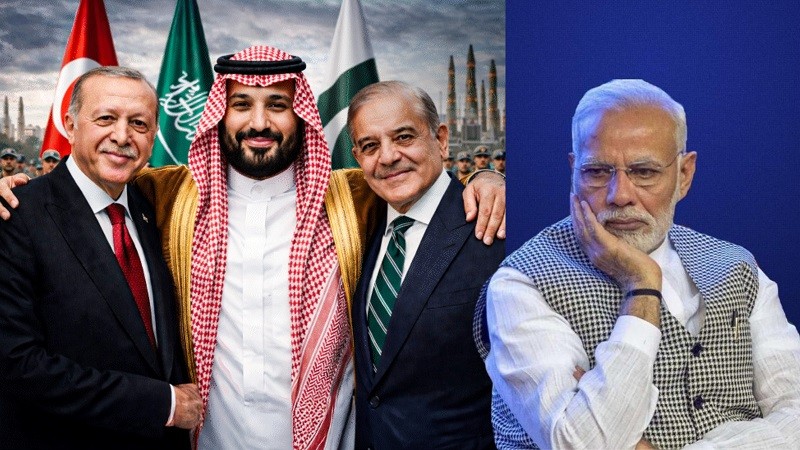
Regional power dynamics are shifting with the emergence of a new defense alliance involving Saudi Arabia, Turkey, and Pakistan. While not explicitly framed as an alliance against a specific country, the coordination of Saudi Arabia’s immense wealth, Turkey’s military technology, and Pakistan’s large military force and nuclear capability is raising concerns over its strategic implications. India, in particular, believes that the development of this new alliance could significantly impact Delhi’s security and strategic position in the future.
According to The Telegraph India, Pakistan has long sought to forge closer ties with Gulf countries across the Strait of Hormuz, metaphorically speaking. Since the 1950s, the country has been training army and air force personnel in various Middle Eastern countries. Now, with the signing of the ‘Makkah Joint Defense Agreement’ with Saudi Arabia and Turkey, Islamabad appears to have moved closer to achieving that goal.
This agreement brings several critical questions to the forefront. Will the close ties with Riyadh bring much-needed financial assistance to Pakistan’s struggling economy? Will advanced Turkish military technology be incorporated into Pakistan’s arsenal? And is this agreement signaling the rise of a powerful new alliance in the Middle East?
The Makkah Defense Agreement signed between Saudi Arabia, Turkey, and Pakistan can be viewed in two ways. Critics of the agreement suggest it lacks significant practical importance. Military alliances typically form around a common enemy, but no such common enemy is clearly defined in this agreement.
Husain Haqqani, Pakistan’s former ambassador to Washington, stated, “Pakistan, Turkey, and Saudi Arabia do not share the same enemies. It is more of a defense cooperation agreement than a military alliance. This could lead to increased intelligence sharing and joint arms production. However, it will not be the ‘Muslim NATO’ that some are calling it.”
According to Haqqani, the agreement is “more symbolic than substantive.”
However, there is another perspective on the agreement. Instead of focusing on what the three countries lack, clarity emerges by considering what they can offer each other. Saudi Arabia brings immense financial capacity to this alliance. Its vast oil wealth provides the means to enhance military capabilities and assist allies.
Turkey’s contribution is no less significant. The country offers military expertise and a burgeoning defense industry. As a NATO member, Turkey has developed its own arms industry over many years and now exports weapons to various countries worldwide.
At the beginning of the Russia-Ukraine war, Turkish-made Bayraktar TB2 drones gained particular prominence. These drones played a role in thwarting the advance of Russian forces and highlighted the importance of drones in modern warfare. Pakistan, on the other hand, brings a capability that the other two countries do not possess: a large and experienced military, and most importantly, nuclear weapons.
This nuclear capability could ultimately become Pakistan’s most significant contribution to the alliance. Saudi Arabia provides finance, Turkey provides technology, and Pakistan provides the greatest deterrent capability. This nuclear umbrella gives the alliance a strategic significance that neither Riyadh nor Ankara could achieve alone.
The agreement states that an attack on any member country will be considered an attack on all three. However, given the differing strategic interests of the three nations, questions remain about whether this commitment would be strictly adhered to in practice. They would need to decide by considering the significant risks of getting embroiled in another member’s conflict. However, there is scope for providing military equipment, intelligence, logistics, or other forms of assistance.
From India’s perspective, Turkey’s role is particularly important. Various reports indicate that Turkish military personnel worked closely with Pakistan during ‘Operation Sindoor’. During the same period, Ankara reportedly supplied hundreds of drones, including Bayraktar TB2s, to Pakistan.
Retired Brigadier Anil Raman of the Indian Army believes that the military impact of Turkey’s role in this alliance cannot be underestimated.
Raman, Head of Defense Fellowship at the Takshashila Institution, said, “From a military standpoint, the risk for India is that Turkey is one of the top producers of drones, electronic warfare systems, and advanced electronic equipment. They have also gained significant real-world combat experience from the Ukraine war.”
According to him, “Battle-tested weapon systems and expertise will increasingly be seen in Pakistan. How Turkey becomes more deeply involved in Pakistan’s military modernization in the next year needs to be monitored closely.”
While Turkey poses a challenge for India, Saudi Arabia’s case is distinct and more complex. Unlike Ankara, Riyadh has significant interests with both India and Pakistan. Saudi Arabia has made substantial investments in India. The country has announced plans to invest up to $100 billion in India across various sectors, from energy to technology.
India is also one of Saudi Arabia’s most important energy buyers. After China and the United States, India is the world’s third-largest importer of crude oil. Similarly, the approximately 4 million Indians living and working in Saudi Arabia are a vital part of the relationship between the two countries.
Due to this mutual dependence, Riyadh must maintain an extremely cautious diplomatic balance.
Indian military planners are concerned that Saudi Arabia’s large investments in India could have unintended implications during a future India-Pakistan crisis. Instead of directly siding with one party, Riyadh might attempt to quickly de-escalate the conflict to prevent it from spiraling out of control.
Raman said, “As the stronger party, we need to win. This requires time to prepare forces, launch attacks, and create the strategic conditions necessary for victory.”
He added, “(If a conflict breaks out with Pakistan) Saudi Arabia would probably want to stop the conflict as quickly as possible. One reason is that they would not want Pakistan to face a significant defeat. Secondly, they have substantial investments in India.”
It is likely due to this balancing act that India’s top leadership is closely monitoring recent developments in the Gulf region. India’s National Security Advisor, Ajit Doval, has visited Saudi Arabia three times in the last six months. Officially, a large part of these visits focused on the implications of the US-Iran conflict. However, it is hard to believe that the Makkah Agreement did not come up in these discussions.
Who is the agreement actually against?
The biggest question surrounding the agreement between Saudi Arabia, Turkey, and Pakistan is who exactly this defense alliance is targeting. India is not a direct target of this agreement. Strategically, however, India could be negatively impacted.
On the other hand, nuclear weapons have little relevance in any conflict with Yemen’s Houthis. Iran could also be a potential party, but none of the three countries seems particularly keen on direct conflict with Tehran.
Therefore, many analysts believe that this agreement should not be viewed as targeting a specific enemy, but rather as a reaction to the changing power dynamics in the Middle East.
The Financial Times recently described the agreement as an “attempt by Gulf countries to mitigate the risk of losing America’s security umbrella.”
Many regional observers share this view. According to them, the United States is no longer willing to guarantee security as it once did. This concern is believed to be the genesis of the agreement. The chaotic US withdrawal from Afghanistan and Washington’s shifting priorities have compelled many Middle Eastern countries to seek additional security arrangements for themselves.
From this perspective, the agreement is more significant as preparation for future uncertainties than as a preparation for war. Raman said, “Saudi Arabia sought security and wanted to reduce its dependence on the United States. Countries under the US security umbrella looked at Afghanistan and thought, ‘If the US can suddenly leave one day, what will become of us?’”
Some analysts also believe that an anti-Israel stance is also significant behind this alliance. The Gaza war, conflicts with Iran, and escalating tensions between Israel and Turkey have altered the strategic calculations in the Middle East. In Raman’s words, “This is more of an anti-Israel alliance than an anti-Iran alliance, and it has serious implications for Israel’s security.”
This leads to another sensitive question: Could Pakistan potentially share some of its nuclear technology with allies in the future? While this seems unlikely for now, some strategists believe the possibility cannot be entirely dismissed. This topic is gaining traction, especially with the escalating rivalry between Turkey and Israel.
According to the Stockholm International Peace Research Institute, Israel possesses approximately 90 nuclear warheads. Some analysts believe Ankara might attempt to develop more robust deterrent capabilities in the future.
Will more countries join the three-nation alliance?
This alliance between Saudi Arabia, Turkey, and Pakistan might not remain limited to just these three countries.
Many analysts believe that Egypt could soon join this alliance. This would significantly expand the alliance’s military strength and geographical reach. Cairo possesses one of the Arab world’s largest militaries. With Egypt’s inclusion, the alliance would establish a significant presence from the Mediterranean Sea to the Gulf.
What is India doing?
Amidst these evolving dynamics, what India is doing is also a crucial question. Rory Stewart, former British minister and co-host of The Rest Is Politics podcast, believes that a counter-alliance might be quietly forming. He pointed to increasing cooperation between India, Israel, the UAE, Greece, and Cyprus.
Indian officials, however, have denied the formation of any formal alliance. However, significant diplomatic activity has been observed among these countries.
In 2023, Modi visited Greece. This was the first visit by an Indian Prime Minister to Greece in four decades. The two countries subsequently elevated their relationship to a strategic partnership. Earlier this year, Greek Prime Minister Kyriakos Mitsotakis met with Modi again.
In June, Modi visited Cyprus. India is also strengthening its ties with Greece and Cyprus. These two countries are set to be crucial parts of the IMEC multimodal corridor, aimed at connecting India with Europe.
Viewed in isolation, these events might seem like normal diplomatic activities. But when taken together, it becomes clear that India, like Saudi Arabia, is adapting to rapidly changing geopolitical circumstances.
The Makkah Agreement may not be the birth of a ‘Muslim NATO’. However, it would be a mistake to dismiss the coordination of Saudi Arabia’s immense wealth, Turkey’s advanced military technology, and Pakistan’s military strength and nuclear arsenal as insignificant.
And one thing is clear: India will need to closely monitor how this alliance evolves.

